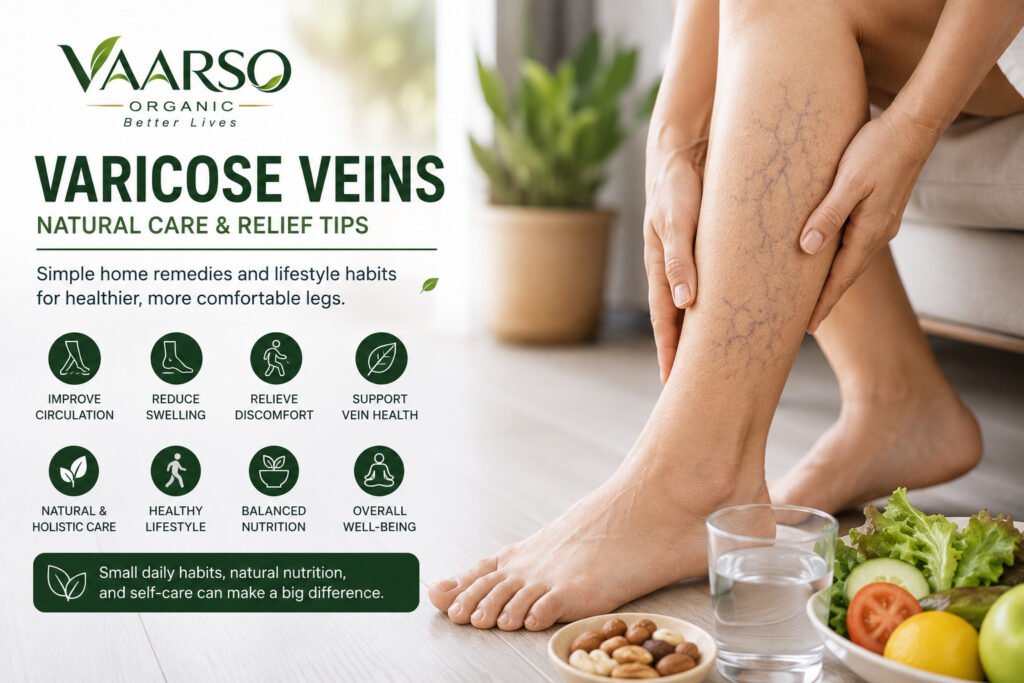
Varicose veins home remedies can be useful for managing some of the discomfort associated with enlarged, twisted veins in the legs. Simple habits such as regular walking, raising your legs when resting, maintaining a healthy weight, avoiding long periods of sitting or standing, and using compression stockings when appropriate can support better circulation and may ease symptoms.
Varicose veins are common around the world. For some people, they are mainly a cosmetic concern. For others, they can cause aching, heaviness, itching, swelling, burning or discomfort, particularly after standing or sitting for a long time.
The good news is that caring for your legs does not always have to be complicated.
Small changes in your daily routine can make a meaningful difference to how your legs feel.
At Vaarso Organic, we believe that natural wellness begins with everyday habits, nourishing foods and a balanced lifestyle. However, it is equally important to understand that home care can support comfort but does not remove established varicose veins or replace professional medical treatment when treatment is needed.
What Are Varicose Veins?
Varicose veins are enlarged veins that commonly appear close to the surface of the skin, especially on the legs.
They may look:
- Blue or purple
- Twisted
- Bulging
- Rope-like
- More prominent after standing for a long time
Veins in the legs have small valves that help blood move back toward the heart. When these valves become weak or do not work properly, some blood can flow backward and collect in the veins. Over time, this can contribute to enlarged and visible veins.
Not everyone with varicose veins has pain.
Some people notice only visible veins, while others may experience:
- Aching legs
- A heavy feeling
- Swelling around the lower legs or ankles
- Itching
- Burning or throbbing
- Muscle cramps
- Discomfort that becomes worse after prolonged standing or sitting
This is why it is useful to pay attention not only to how your veins look but also to how your legs feel.
1. Wear Compression Stockings When Appropriate
Compression stockings are one of the better-established non-surgical options for managing symptoms associated with varicose veins.
They gently squeeze the legs, which can help veins and leg muscles move blood upward toward the heart. They may help with symptoms such as aching and swelling.
Compression stockings come in different lengths and levels of pressure. The right type depends on your individual situation.
If you have circulation problems, significant swelling, diabetes, skin problems or another medical condition, speak with a healthcare professional before choosing compression garments.
Important: Compression stockings should not simply be treated like ordinary socks. The correct size and compression level matter.
2. Make Walking Part of Your Daily Routine
Walking is one of the simplest habits you can add to a natural leg-care routine.
When you walk, the muscles in your lower legs contract and help push blood through the veins. Regular movement can therefore support circulation.
You don’t necessarily need a complicated workout.
Try:
- A short walk after meals
- Walking during work breaks
- Taking the stairs when comfortable
- Moving around after sitting for a long time
- Gentle ankle and calf movements
Mayo Clinic specifically lists regular exercise, including walking, among self-care measures for varicose veins.
If exercise causes significant pain or swelling, don’t push through it. Choose a gentler activity and discuss persistent symptoms with a healthcare professional.
3. Elevate Your Legs When You Rest
After a long day, your legs may feel tired, heavy or swollen.
One simple thing you can try is raising your legs while sitting or lying down.
For example, you can place your legs on a few pillows while resting. Elevating the legs above the level of the heart for short periods can help support the return of blood from the legs.
You don’t need to spend hours doing this.
A few short breaks during the day may be easier to maintain than one long session.
Think of it as giving your legs a little break from gravity.
4. Avoid Sitting or Standing in One Position for Too Long
Modern lifestyles can be surprisingly hard on our legs.
You might spend several hours:
- Sitting at a desk
- Driving
- Standing at work
- Working behind a counter
- Watching television
- Travelling
Staying in one position for long periods can make leg discomfort worse.
Try changing position regularly.
If you work at a desk, stand up and walk around periodically.
If your job requires standing, take short opportunities to sit and move your ankles or walk around when possible.
The important thing is movement rather than remaining completely still for hours.
Mayo Clinic and the NHS both recommend avoiding prolonged sitting or standing as part of varicose-vein self-care.
5. Maintain a Healthy Weight
Body weight can affect the amount of pressure placed on the veins of the legs.
If you are carrying excess weight, gradual and sustainable weight management may be beneficial for overall health and may reduce pressure on the veins.
This doesn’t mean crash diets or extreme fasting.
Instead, focus on:
- Regular movement
- Balanced meals
- Adequate protein
- Plenty of vegetables
- Whole grains
- Fruits
- Appropriate portion sizes
- Good hydration
A healthy lifestyle is more useful when it is something you can continue for months and years.
6. Pay Attention to Your Diet
There is no single food that can make varicose veins disappear.
However, your overall diet matters for general cardiovascular health, healthy weight management and bowel health.
A balanced diet can include:
Fruits and vegetables
Choose a variety of colourful fruits and vegetables.
Examples include:
- Oranges
- Berries
- Tomatoes
- Leafy greens
- Bell peppers
- Carrots
- Broccoli
These foods provide vitamins, minerals, fibre and other naturally occurring plant compounds.
High-fibre foods
Fibre is important for digestive health and can help support regular bowel movements.
Good choices include:
- Oats
- Whole grains
- Beans
- Lentils
- Fruits
- Vegetables
- Seeds
- Nuts
Healthy fats
Include appropriate amounts of foods such as:
- Nuts
- Seeds
- Avocado
- Olive oil
- Fatty fish, where suitable
The goal isn’t to follow a special “varicose vein diet.”
The goal is simply to build a nutritious eating pattern that supports your overall health.
7. Don’t Overdo Salt
A diet high in sodium can contribute to fluid retention in some people.
Reducing excessive salt intake can therefore be a sensible part of a healthy diet, particularly for people who experience swelling. Mayo Clinic includes avoiding excess salt among lifestyle measures for varicose veins.
Instead of relying heavily on salt for flavour, try herbs, spices, lemon, garlic or other natural flavourings.
However, don’t eliminate sodium completely unless advised by a healthcare professional. Sodium is an essential nutrient.
8. Stay Hydrated
Water doesn’t cure varicose veins, but adequate hydration is an important part of general health.
Rather than waiting until you’re extremely thirsty, drink fluids regularly throughout the day.
Your individual fluid requirements can vary depending on:
- Climate
- Physical activity
- Age
- Body size
- Pregnancy
- Medical conditions
- Medications
People with certain heart, kidney or liver conditions may have specific fluid restrictions, so individual medical advice takes priority.
9. Be Careful With Home Massage
Massage is sometimes promoted online as a treatment for varicose veins.
This needs a little caution.
If you have visible, painful or swollen veins, avoid vigorous massage directly over the affected veins.
A healthcare professional can advise you about whether massage is appropriate for your particular condition.
Likewise, essential oils such as lavender, rosemary or peppermint may smell pleasant, but they should not be presented as proven treatments for varicose veins.
If you use an essential oil for general skincare, it should be properly diluted and patch-tested. Never apply concentrated essential oils directly to the skin.
10. What About Apple Cider Vinegar?
Apple cider vinegar is frequently mentioned online as a home remedy for varicose veins.
However, there isn’t strong clinical evidence that applying apple cider vinegar to the skin can repair damaged vein valves or eliminate varicose veins.
Applying undiluted vinegar to the skin can also cause irritation or burns.
So while apple cider vinegar can be used as a food ingredient for some people, it should not be promoted as a proven varicose-vein treatment.
This is an important distinction when choosing natural wellness advice.
Natural does not automatically mean effective or risk-free.
11. Aloe Vera and Onion: A Traditional Remedy With Limited Evidence
Aloe vera and onion-based mixtures are sometimes suggested in traditional home-remedy discussions.
Although these ingredients have interesting nutritional and traditional uses, there is not enough reliable clinical evidence to claim that applying an aloe-and-onion mixture to varicose veins will improve damaged veins or restore normal venous valves.
If you have sensitive skin, eczema, an ulcer or broken skin around your veins, avoid experimenting with homemade mixtures.
For persistent symptoms, proper medical assessment is a better choice.
12. What About Cumin, Black Cumin and Herbal Drinks?
Cumin and black cumin are widely used as culinary ingredients in different parts of the world.
They can certainly be part of a varied diet.
However, drinking cumin or black-cumin water should not be described as a treatment for varicose veins.
There is a big difference between:
“This food is nutritious.”
and
“This food treats a vein condition.”
At Vaarso Organic, we believe responsible natural wellness content should make that difference clear.
13. Can Yoga Help?
Gentle physical activity can be useful for overall mobility and circulation.
Some people enjoy yoga because it combines movement, stretching, breathing and relaxation.
However, no particular yoga posture should be described as a cure for varicose veins.
If you enjoy yoga, choose comfortable movements that don’t cause pain or excessive pressure in your legs.
You can also discuss suitable exercises with a physiotherapist or healthcare professional if your symptoms are significant.
14. Choose Comfortable Footwear
Your everyday footwear can affect how comfortably you move.
Comfortable shoes can make walking and regular movement easier.
If possible:
- Choose supportive footwear
- Avoid shoes that cause pain
- Avoid spending long periods in uncomfortable high heels
- Make sure your shoes fit properly
Mayo Clinic notes that lower-heeled footwear allows the calf muscles to work more effectively than high heels.
Nutrition for Natural Varicose Vein Care
There isn’t a special nutrient that can “repair” varicose veins.
Instead, focus on an overall nutritious diet.
| Nutrient / Food Component | Food Sources | Why It Matters |
|---|---|---|
| Fibre | Oats, beans, vegetables, fruits, whole grains | Supports digestive health |
| Vitamin C | Citrus fruits, berries, peppers, tomatoes | Supports normal body functions |
| Vitamin E | Nuts, seeds, vegetable oils | Important antioxidant nutrient |
| Potassium | Bananas, beans, potatoes, leafy greens | Important for normal body functions |
| Protein | Eggs, beans, lentils, fish, dairy, tofu | Supports muscles and tissues |
| Healthy fats | Nuts, seeds, olive oil, fish | Part of a balanced diet |
The key is variety.
You don’t need to buy expensive “superfoods” to eat well.
Simple foods eaten consistently can form the foundation of a healthy diet.
How to Build a Simple Daily Varicose Vein Care Routine
Here’s an easy routine you can adapt to your lifestyle.
Morning
Start the day with normal hydration and a balanced breakfast.
If you have time, include a short walk or gentle movement.
During work
If you’re sitting, get up and move regularly.
If you’re standing, change position and walk when possible.
Afternoon
Choose a balanced meal containing vegetables, protein and a source of whole-food carbohydrates.
Evening
Take a gentle walk if comfortable.
Avoid spending the entire evening sitting in one position.
Before bed
If your legs feel tired or swollen, spend some time resting with your legs elevated.
Most importantly, make these habits regular rather than trying several remedies for a few days and giving up.
Can Vaarso Organic Products Help With Varicose Veins?
This is where we recommend being particularly careful with product claims.
Vaarso Organic products should not be presented as medicines or as treatments that cure varicose veins.
If you’re already using products such as herbal powders as part of your normal diet, they can be considered in the context of your overall nutritional routine, provided they are suitable for you and used according to their product directions.
For example, a product such as Vaarso Organic Wheatgrass Powder can be discussed as a convenient way to add a plant-based powder to smoothies or other foods. But it should not be marketed as something that treats or removes varicose veins.
Similarly, Vaarso Organic Triphala Powder may be discussed around traditional digestive wellness, but it should not be presented as a treatment for varicose veins.
For Vaarso Organic, this approach is better for long-term customer trust: promote the product for what it is, rather than promising a medical result it cannot guarantee.
What Not to Do If You Have Varicose Veins
Avoid relying entirely on internet home remedies if symptoms are getting worse.
Be particularly careful about:
❌ Vigorous massage directly over painful veins
❌ Applying undiluted essential oils
❌ Applying vinegar to irritated or broken skin
❌ Using homemade mixtures on ulcers or wounds
❌ Taking herbal products as substitutes for prescribed treatment
❌ Staying completely inactive because your legs hurt
❌ Sitting or standing in one position for many hours
❌ Ignoring persistent swelling or pain
Natural care should complement sensible healthcare—not replace it.
When Should You See a Doctor?
Most varicose veins aren’t emergencies, but they shouldn’t always be ignored.
Consider seeking medical advice if you have:
- Persistent leg pain
- Significant swelling
- Itching or skin changes
- A sore that doesn’t heal
- Symptoms that are getting worse
- Bleeding from a varicose vein
- Significant heaviness or discomfort
The NHS recommends medical evaluation when varicose veins cause symptoms such as pain, itching or swelling, when they are worsening, or when a leg ulcer does not heal.
There are also situations where urgent medical attention is important.
Sudden leg swelling or pain can sometimes be associated with a blood clot. If leg symptoms are accompanied by chest pain or shortness of breath, seek emergency medical care immediately, because a clot can travel to the lungs.
Frequently Asked Questions
1. Can varicose veins go away naturally?
Some mild symptoms may become easier to manage with lifestyle changes, but established varicose veins do not necessarily disappear on their own. Self-care can help manage discomfort and may help prevent symptoms from worsening.
2. Is walking good for varicose veins?
Walking is generally a useful low-impact activity because the calf muscles help support blood movement in the legs.
3. Should I wear compression stockings every day?
Compression stockings are commonly used during the day to manage symptoms, but the appropriate pressure and type depend on the individual. Ask a healthcare professional if you are unsure which compression level is appropriate.
4. Can elevating my legs reduce swelling?
Leg elevation can help support blood flow back from the legs and may reduce swelling and discomfort.
5. Is apple cider vinegar a cure for varicose veins?
No. There isn’t strong evidence that apple cider vinegar can repair varicose veins or correct faulty vein valves.
6. Can massage remove varicose veins?
Massage cannot repair the underlying valve problems responsible for varicose veins. Avoid vigorous massage directly over painful or prominent veins.
7. What foods are good for healthy veins?
There isn’t one special food. A balanced diet containing vegetables, fruits, whole grains, legumes, nuts, seeds and appropriate protein sources is a sensible approach to overall health.
8. Can yoga cure varicose veins?
Yoga can be part of an active lifestyle, but no particular yoga posture should be considered a cure for varicose veins.
9. Does losing weight help varicose veins?
If you are carrying excess weight, gradual weight management can reduce pressure on the veins and support overall health.
10. Can Vaarso Organic herbal powders cure varicose veins?
No Vaarso Organic herbal powder should be presented as a cure for varicose veins. Products can be incorporated into a healthy lifestyle when appropriate, but persistent vein symptoms should be evaluated by a healthcare professional.
Final Thoughts
Varicose veins can be uncomfortable, but taking care of your legs doesn’t have to be complicated.
Start with the basics:
– Walk regularly.
– Move often.
– Elevate your legs when resting.
– Maintain a healthy weight.
– Eat a balanced diet.
– Avoid excessive salt.
– Consider appropriate compression stockings.
– Don’t ignore persistent symptoms.
These simple habits may help you feel more comfortable and support healthier circulation.
At Vaarso Organic, our philosophy is simple: natural wellness should be practical, balanced and honest. Herbal foods and traditional ingredients can have a place in everyday wellness, but they should never replace proper medical care when a health condition requires it.
Your legs carry you through life. Give them a little care every day. 🌿
This article is for general educational purposes only and is not intended to diagnose, treat, cure or prevent any disease. If you have painful, worsening or unusual symptoms, consult a qualified healthcare professional.