
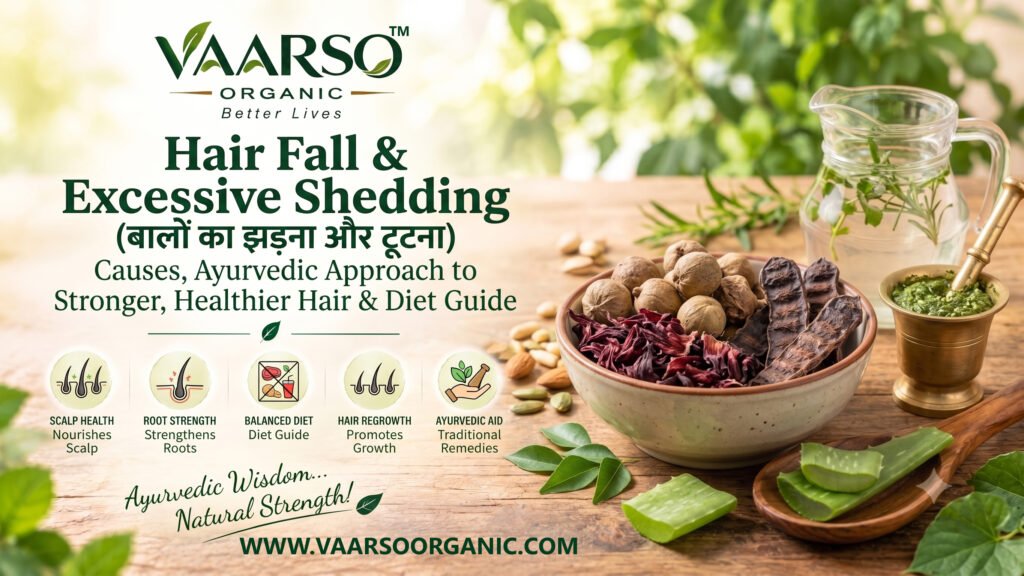
Hair Fall & Excessive Hair Shedding: Ayurvedic Approach, Nutrition & Hair Care
Hair on the pillow, strands on the comb, more hair than usual in the shower drain—these small signs can become worrying when they happen every day.
Hair fall is not simply a cosmetic concern. Hair growth is influenced by genetics, hormones, nutrition, scalp health, illness, stress, medications and everyday hair-care habits. Hereditary hair loss is one of the most common causes worldwide, while thyroid problems, nutrient deficiencies, major illness, pregnancy-related changes, tight hairstyles and inflammatory scalp conditions can also contribute.
This is where Ayurveda offers an interesting perspective. Rather than looking at hair as something completely separate from the body, traditional Ayurvedic thinking connects healthy hair with Ahara (food), Agni (digestion and metabolism), Dinacharya (daily routine), nourishment and overall balance.
At Vaarso Organic, we believe natural wellness should be approached thoughtfully—not through miracle claims, but through better food, sensible traditional practices and an understanding of what your body actually needs.
One traditional combination often discussed for hair wellness includes Bhringraj, Amla and Brahmi. However, it is important to understand that traditional use is not the same as proven treatment for every type of hair loss.
What Is Hair Fall? 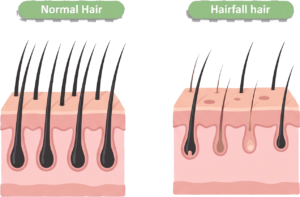
Some hair shedding is completely normal. The American Academy of Dermatology notes that losing around 50–100 hairs a day can be part of the normal hair-growth cycle. Concern increases when shedding becomes noticeably heavier, the hairline recedes, the part becomes wider, bald patches appear, or overall density continues to decrease.
Hair growth occurs in cycles. Individual follicles move through growing, resting and shedding phases. A temporary disturbance—such as significant illness, severe stress, rapid weight loss or hormonal changes—can shift more hairs into the shedding phase.
Other people experience gradual thinning because of hereditary factors.
That distinction matters because there is no single Ayurvedic remedy or modern treatment that works for every kind of hair loss.
Finding the reason for hair fall is often the first and most important step.
Why Does Hair Fall Increase?
Hair shedding can have many causes.
1. Hereditary hair loss
Genetic hair loss, also called androgenetic alopecia, affects both men and women. Men may notice a receding hairline or thinning at the crown, while women commonly notice overall thinning or a widening part.
2. Stress and major life events
Emotional stress, significant illness, surgery, high fever or major changes in the body can sometimes trigger increased shedding months later.
3. Poor nutrition
Hair follicles require adequate nutrients to produce healthy hair. Insufficient protein, iron, zinc or certain vitamins can contribute to hair loss. Eating too few calories can also cause significant shedding.
4. Hormonal or thyroid problems
Thyroid disorders and hormonal changes associated with pregnancy, childbirth and menopause can affect hair growth.
5. Scalp problems
Inflammation, infections and conditions such as alopecia areata can cause different patterns of hair loss.
6. Hair-care practices
Frequent chemical treatments, excessive heat, rough brushing and hairstyles that continuously pull on the hair may contribute to breakage or hair loss. 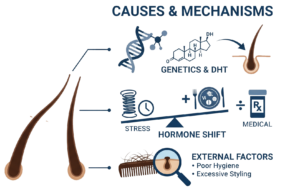
So before asking, “Which herb will stop my hair fall?”, a better question is:
“Why is my hair falling in the first place?”
Ayurveda and Hair Health: Looking Beyond the Hair Strand
Ayurveda traditionally views the body as an interconnected system.
Healthy hair is not only about what is applied to the scalp. Traditional wellness emphasizes Ahara, Vihara and Dinacharya—food, lifestyle and daily habits.
From an Ayurvedic perspective, nourishment, digestion, sleep, stress and individual constitution can all be considered when developing a wellness routine.
Classical Ayurvedic traditions have also used herbs such as Bhringraj, Amla and Brahmi in different preparations.
Modern scientific research on herbal approaches to hair loss is still developing. Reviews suggest that some herbs and plant-based ingredients show potential, but many studies are small or have methodological limitations, so stronger clinical research is needed before these remedies can be considered established treatments.
That distinction is important.
Ayurveda can provide traditional wisdom and complementary wellness practices, but significant or persistent hair loss deserves proper evaluation.
3 Traditional Ayurvedic Herbs for Hair Wellness
1. Bhringraj – The Traditional Hair Herb
Bhringraj (Eclipta prostrata/Eclipta alba) has a long association with traditional Indian hair care.
In Ayurveda-inspired hair routines, Bhringraj is commonly used in oils, pastes and herbal preparations.
Traditional benefits of Bhringraj
Bhringraj is traditionally valued for:
- Supporting scalp and hair-care routines
- Nourishing the scalp
- Maintaining healthy-looking hair
- Supporting traditional approaches to hair strength
- Being used in herbal hair oils
It is important not to interpret these traditional uses as proof that Bhringraj can reverse genetic baldness or cure alopecia.
How Bhringraj can be used
For everyday external hair care, Bhringraj is commonly found in traditional hair oils.
A gentle scalp massage with a suitable herbal oil can become part of a relaxing weekly routine.
2. Amla – A Traditional Source of Nourishment
Amla (Indian gooseberry) has a special place in Indian food and Ayurvedic tradition.
It is naturally rich in vitamin C and contains various plant compounds. Traditional Ayurvedic preparations have used Amla for general wellness and hair care.
Interestingly, the Central Council for Research in Ayurvedic Sciences (CCRAS) lists traditional Amla preparations among home remedies used for hair fall and dandruff, including topical application of soaked Amla fruit rind.
Potential benefits of Amla in a hair-care routine
Amla may be included for:
- Nutritional support
- Traditional scalp care
- Antioxidant-rich dietary support
- Supporting a balanced diet
- Traditional hair-care preparations
Fresh Amla can also be enjoyed as a food rather than treating it only as a supplement.
This is an important Ayurvedic idea: food itself can become part of daily wellness.
3. Brahmi – Traditionally Associated With Calm and Balance
Brahmi is another well-known Ayurvedic herb.
Traditional Indian wellness practices have associated Brahmi with mental calmness, concentration and nervous-system support.
Why is that relevant to hair?
Because modern life often combines poor sleep, long working hours, emotional stress and irregular routines. Stress itself can contribute to excessive shedding in some people.
That does not mean Brahmi directly stops hair loss.
Rather, it can be viewed as part of a broader calm, balanced lifestyle approach.
A Traditional Herbal Powder Combination
The traditional recipe shared for this topic contains:
- Bhringraj powder – 100 g
- Amla powder – 150 g
- Brahmi powder – 100 g
- Pure sugar or licorice powder – 50 g
The ingredients are traditionally combined into a homogeneous powder.
However, Vaarso Organic does not recommend treating this traditional recipe as a universal medical prescription or assuming that everyone should take it internally.
The original recipe suggests one teaspoon twice daily after meals, but there is no universally established clinical dose for this combination for hair loss.
There is also an important safety distinction between sugar and licorice.
Why be careful with licorice?
Licorice (Glycyrrhiza glabra) has a long history in traditional medicine, but oral licorice containing glycyrrhizin can cause problems when consumed in larger amounts or for prolonged periods. It can raise blood pressure, lower potassium and interact with certain medicines. People with hypertension, heart or kidney conditions need particular caution.
Therefore, licorice should not simply be substituted into a homemade hair supplement without professional advice.
Pregnant or breastfeeding individuals, children and people taking regular medicines should especially discuss internal herbal preparations with a qualified healthcare professional.
Benefits of a Holistic Ayurvedic Hair-Care Routine
A sensible Ayurvedic-inspired hair routine can focus on several areas rather than relying on one powder.
1. Nutritional support
Healthy hair requires adequate overall nutrition.
2. Scalp care
Keeping the scalp clean and avoiding unnecessary irritation supports a healthy hair-care environment.
3. Gentle oil massage
Traditional oil massage can be a relaxing part of personal care and may help reduce rough handling of the hair.
4. Stress management
Breathing exercises, yoga, meditation, walking and adequate sleep can support overall wellbeing.
5. Consistency
Hair does not transform overnight. Healthy habits need time.
Nutrition for Stronger-Looking Hair
One of the biggest mistakes people make is searching for a single “hair-growth food.”
There isn’t one magical food.
Instead, think about the entire plate.
Protein
Hair is largely made of a protein called keratin.
Include suitable protein sources such as:
- Eggs
- Yogurt
- Milk or dairy alternatives
- Lentils
- Beans
- Chickpeas
- Tofu
- Fish or lean meat, if included in your diet
- Nuts and seeds
Iron
Iron deficiency can contribute to hair loss.
Food sources include:
- Lentils
- Beans
- Leafy greens
- Seeds
- Fortified foods
- Meat and seafood for people who eat them
If iron deficiency is suspected, testing is more useful than blindly taking iron supplements.
Zinc
Zinc contributes to normal physiological processes and is found in foods such as seeds, nuts, beans, dairy and meat.
Healthy fats
Nuts, seeds, avocado, olive oil and other unsaturated-fat sources can be part of a balanced diet.
Fruits and vegetables
A colourful diet provides vitamin C, folate, carotenoids and many other nutrients and plant compounds.
Amla, berries, citrus fruits, leafy vegetables and other colourful produce can all have a place in a healthy diet.
What About Biotin?
Biotin is frequently marketed as a “hair vitamin.”
But more is not necessarily better.
Biotin deficiency can cause hair thinning, but deficiency is relatively uncommon, and there is limited evidence that high-dose biotin supplements improve hair in people who are not deficient. High-dose biotin can also interfere with certain laboratory tests.
The better approach is:
Test when appropriate → identify the deficiency → correct the deficiency.
The American Academy of Dermatology similarly advises against taking iron, zinc or biotin simply because hair is falling unless testing or professional evaluation indicates a deficiency. Excess amounts of some nutrients can actually be harmful and may worsen hair loss.
How to Use Ayurvedic Hair Oils
External oiling is one of the simplest traditional practices to incorporate into a routine.
Simple method
- Choose a suitable coconut, Amla or Bhringraj-based hair oil.
- Apply a modest amount to the scalp.
- Massage gently with your fingertips.
- Avoid aggressive rubbing or scratching.
- Leave it on according to the product directions and your scalp tolerance.
- Wash with a gentle cleanser.
You do not need to massage forcefully.
Hair follicles don’t become stronger because the scalp is vigorously rubbed.
Gentle, consistent care is usually more sensible.
How Often Should You Oil Your Hair?
For many people, 1–2 times a week is a practical starting point.
Some people may prefer more frequent oiling, while others with an oily scalp, dandruff or scalp inflammation may find heavy oiling uncomfortable.
Listen to your scalp.
If an oil causes itching, redness, pimples or worsening dandruff, discontinue it.
Everyday Habits That Can Help Protect Hair
Your hair routine does not need to be complicated.
Do:
- Eat enough nutritious food.
- Include adequate protein.
- Drink enough fluids for your individual needs.
- Sleep regularly.
- Manage chronic stress.
- Handle wet hair gently.
- Avoid excessively tight hairstyles.
- Limit unnecessary heat and chemical treatments.
- Keep the scalp clean.
- Use a gentle comb.
- Treat dandruff or scalp conditions appropriately.
Avoid:
- Crash diets
- Extreme calorie restriction
- Excessive supplement use
- Repeated harsh chemical treatments
- Very tight hairstyles
- Aggressive scalp scratching
- Random high-dose “hair vitamins”
- Expecting one herb to reverse every type of hair loss
When Should You See a Doctor or Dermatologist?
This is one of the most important sections of any responsible hair-loss article.
Consider professional evaluation if you notice:
- Sudden heavy shedding
- Rapid thinning
- Round or sharply defined bald patches
- Receding hairline
- Significant scalp itching, pain or scaling
- Eyebrow or eyelash loss
- Hair loss after starting a medicine
- Hair loss accompanied by fatigue or other symptoms
- Persistent shedding for several months
- Hair loss during pregnancy or after childbirth that concerns you
A dermatologist may examine the scalp and, when appropriate, recommend blood tests for possible nutritional deficiencies, thyroid problems or other causes.
Some forms of hair loss require early treatment to prevent permanent follicle damage.
Modern treatments such as topical minoxidil may be appropriate for certain types of hair loss, while other conditions require completely different approaches.
Ayurvedic practices can be considered complementary, but they should not delay diagnosis or proven treatment when a medical condition is present.
Ayurveda and Hair: A Cultural Perspective
In Indian culture, hair has never been viewed merely as a physical feature.
From traditional oiling rituals to the use of Amla, Bhringraj and other herbs, hair care has often been connected with self-care, family traditions and daily rhythm.
The practice of applying oil before bathing is still familiar in many households.
But perhaps the deeper lesson is more relevant today than ever:
Hair care is not only about what we put on the scalp. It is also about how we live.
Modern life often brings irregular meals, insufficient sleep, prolonged screen time, sedentary habits and chronic stress.
The Ayurvedic concept of Dinacharya—a thoughtful daily routine—offers a useful way to think about wellness.
Eat regularly.
Sleep properly.
Move your body.
Make time to breathe.
Choose nourishing foods.
Care for yourself consistently.
That philosophy can be valuable even when we separate traditional concepts from modern medical claims.
A Simple Daily Hair-Wellness Routine
Morning
Start with a balanced breakfast containing protein, whole foods and fruit or vegetables.
During the day
Stay hydrated according to your individual needs and eat a varied diet.
Evening
Take a walk, practise relaxation or spend a few minutes away from screens.
Weekly
Use a gentle scalp-care routine and, if suitable for your scalp, massage with a traditional hair oil.
Every few months
If hair shedding is increasing, don’t simply keep changing supplements. Look for the cause.
Final Thoughts: Healthy Hair Begins With Healthy Habits 
Hair fall can be frustrating, especially when it seems to happen without warning.
Ayurveda offers a beautiful reminder that wellness is a daily practice rather than a quick fix.
Bhringraj, Amla and Brahmi have important places in traditional Indian herbal culture, and they can be part of a thoughtful hair-care routine. But they should not be presented as guaranteed cures for baldness, genetic hair loss, alopecia or medically caused shedding.
The most practical approach combines good nutrition, gentle hair care, adequate sleep, stress management, scalp care and appropriate medical evaluation when needed.
At Vaarso Organic, we believe natural wellness is strongest when tradition and responsible modern knowledge work together.
Ayurveda is not simply about taking a herb. It is about learning the art of living well.
Vaarso Organic — Better Lives.
FAQs About Hair Fall & Ayurvedic Hair Care
1. Is hair fall completely normal?
Some daily shedding is normal. Around 50–100 hairs per day can fall as part of the normal hair cycle. Excessive shedding, visible thinning, bald patches or a receding hairline deserve closer attention.
2. Can Bhringraj stop hair loss?
Bhringraj has a long history of traditional use in Indian hair care. However, evidence is not strong enough to say that it can stop every form of hair loss or reverse genetic baldness.
3. Is Amla good for hair?
Amla is traditionally used for hair and scalp care and is also a nutritious fruit. It can be included in a balanced diet or used in traditional topical preparations.
4. Can Brahmi help with hair fall?
Brahmi is traditionally associated with mental wellness and is also used in some Ayurvedic hair preparations. It should be viewed as part of a broader wellness routine rather than a proven cure for hair loss.
5. Can I take Bhringraj, Amla and Brahmi powder every day?
Internal herbal combinations should not automatically be treated as suitable for everyone. The appropriate ingredients, quantities and duration depend on the individual. Consult a qualified Ayurvedic practitioner or healthcare professional before regular internal use.
6. Does oiling stop hair fall?
Oiling can be a useful traditional hair-care practice and may reduce dryness and improve the feel of hair. It cannot be expected to treat every underlying cause of hair loss.
7. How often should I oil my hair?
For many people, once or twice a week is a reasonable starting point. Your scalp type and the specific oil matter.
8. Is biotin necessary for hair growth?
Biotin is important when someone is deficient, but routine high-dose biotin supplementation is not supported by strong evidence for people without deficiency.
9. Can poor nutrition cause hair loss?
Yes. Inadequate protein, iron, zinc and certain other nutrients can contribute to hair loss. Severe calorie restriction can also trigger significant shedding.
10. Does stress cause hair fall?
Significant physical or emotional stress can contribute to temporary excessive shedding in some people. However, persistent hair loss can have several causes and should not automatically be blamed on stress.
11. Can licorice powder be used in a hair-fall mixture?
Licorice has a traditional history, but oral licorice containing glycyrrhizin can affect blood pressure and potassium and can interact with medicines. It should not be casually added to a daily internal hair supplement.
12. When should I see a dermatologist?
See a dermatologist if hair loss is sudden, severe, persistent, patchy, associated with scalp symptoms, or accompanied by other health changes. Finding the cause is essential because different types of hair loss require different treatments.
13. Can Ayurveda replace medical treatment for hair loss?
Ayurvedic approaches can be complementary, but they should not replace appropriate medical diagnosis or proven treatment. Some causes of hair loss need specific medical care.
14. What is the best natural approach to healthy hair?
Think beyond one ingredient: eat a varied nutritious diet, get enough protein, sleep well, manage stress, care for your scalp gently and investigate persistent hair loss rather than relying only on supplements.