
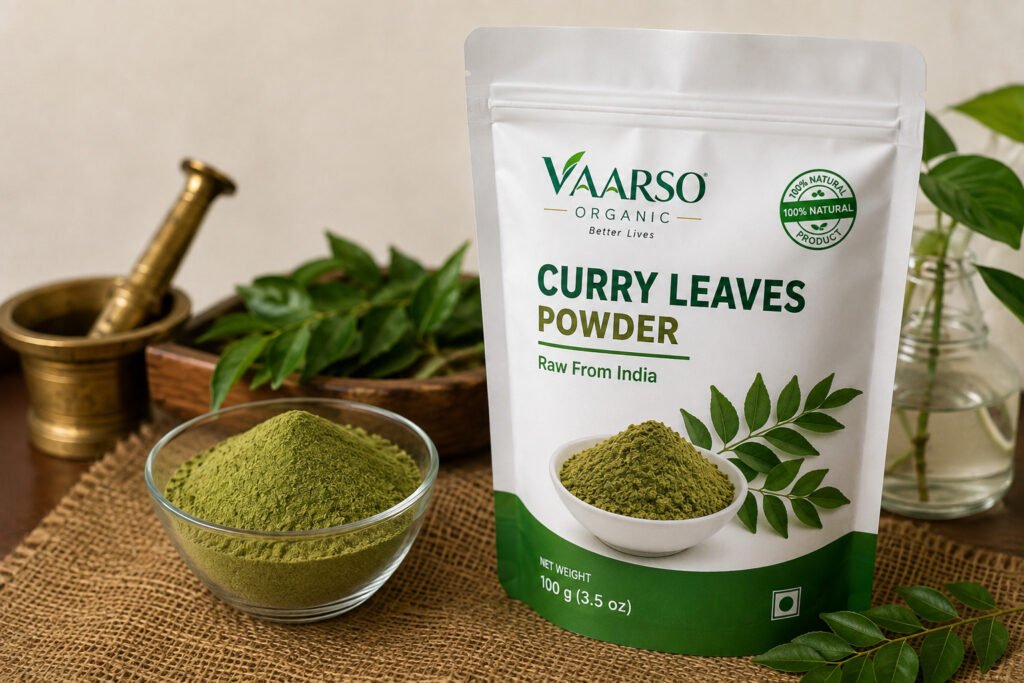
Curry leaves are one of those ingredients that can make a dish smell like home.
Add a few fresh leaves to hot oil with mustard seeds, cumin or chillies, and suddenly a simple dal, curry or rice dish has a completely different aroma. Curry leaves have been used in Indian and South Asian cooking for generations, not only for their flavour but also as a traditional plant ingredient.
The only problem with fresh curry leaves is that they don’t always last very long. Sometimes you have a bunch sitting in the refrigerator, and before you know it, they’ve lost their freshness.
That’s where Curry Leaves Powder can be useful.
Made from dried curry leaves and ground into a convenient powder, it gives you an easy way to keep the familiar flavour of curry leaves available in your kitchen. You can add it to dal, rice, chutneys, vegetables, buttermilk, soups and homemade spice mixes.
At Vaarso Organic, we like ingredients that fit naturally into everyday life. Curry Leaves Powder is not something that requires an elaborate routine. It is simply an easy-to-use plant ingredient that can be added to the food you already enjoy.
But curry leaves are more than just a flavouring ingredient. They contain naturally occurring plant compounds, vitamins, minerals and other phytochemicals that have been studied for their nutritional and biological properties.
So, let’s take a closer look at curry leaf powder, its nutrition, traditional uses, potential benefits and some simple ways to use it at home.
What Is Curry Leaves Powder?
Curry Leaves Powder is made from the leaves of the curry leaf plant, scientifically known as Murraya koenigii.
The fresh leaves are dried and then finely ground to create a powder. Drying makes the leaves much easier to store and use compared with fresh curry leaves.
The powder usually has a green to greenish-brown colour and a distinctive herbal aroma. Its taste is earthy, slightly bitter and aromatic, with the familiar character of curry leaves.
One thing worth clearing up is that curry leaf powder and curry powder are not the same thing.
Curry leaf powder comes from dried curry leaves. Curry powder, on the other hand, is generally a mixture of several spices.
So, if you’re looking for the flavour of curry leaves without using fresh leaves, curry leaf powder is the more direct option.
Why Are Curry Leaves So Popular in Indian Cooking?
Walk into many Indian kitchens and you’ll probably find curry leaves somewhere nearby.
They are particularly common in South Indian cooking, but their use extends across many parts of India and other South Asian cuisines.
Curry leaves are often added to hot oil or ghee as part of a tempering. The heat releases their aroma, which then spreads through the dish.
They can be used in:
- Dal
- Sambar
- Rasam
- Vegetable curries
- Coconut chutneys
- Rice dishes
- Poha
- Upma
- Buttermilk
- Snacks
- Homemade spice blends
Their popularity comes down to something quite simple: a little curry leaf can add a lot of character to food.
Curry leaves have also been used traditionally in various food and herbal preparations. Modern research has identified numerous phytochemicals in Murraya koenigii, including flavonoids, phenolic compounds, carotenoids, alkaloids and terpenoids.
Curry Leaves Powder Nutrition
Curry leaves have an interesting nutritional profile.
Research has found that the leaves contain various nutrients and plant compounds, although the exact amounts can differ depending on the variety, growing conditions, maturity, processing and method of analysis.
Some naturally occurring components associated with curry leaves include:
Vitamins
Curry leaves contain several vitamins and vitamin-related compounds, including carotenoids associated with vitamin A activity and B-group vitamins. Research has also identified vitamin C and vitamin E in curry leaf samples.
Minerals
Curry leaves contain minerals such as calcium, magnesium and other mineral nutrients.
The amount you actually consume from a normal serving of curry leaf powder will, of course, depend on how much you use.
Dietary Fibre
Curry leaves contain naturally occurring fibre. Including a variety of plant foods in the diet is one of the easiest ways to increase dietary diversity and fibre intake.
Plant Compounds
Perhaps one of the more interesting aspects of curry leaves is their phytochemical profile.
Studies have identified compounds belonging to groups such as polyphenols, flavonoids, alkaloids, terpenoids and carotenoids.
This is one reason curry leaves continue to receive attention from researchers.
Curry Leaves Powder Benefits
When searching online for Curry Leaves Powder benefits, you’ll find some very strong health claims.
It’s important to separate traditional use and early scientific research from proven medical effects.
Curry leaves contain several interesting plant compounds, and laboratory and animal studies have investigated antioxidant and other biological activities. However, that does not mean curry leaf powder should be considered a treatment for a medical condition. More human research is needed to establish many of the health claims commonly made online.
With that in mind, here are some sensible reasons to include curry leaves in your diet.
1. Naturally Contains Antioxidant Compounds
Curry leaves contain plant compounds such as flavonoids and phenolics that have demonstrated antioxidant activity in research.
Antioxidants are compounds that help protect cells from oxidative stress.
Rather than looking for one food to provide all your antioxidant needs, it’s better to eat a variety of vegetables, fruits, herbs, spices, nuts and seeds.
Curry Leaves Powder can simply be one more plant ingredient in that mix.
2. Adds Plant-Based Variety to Your Diet
One of the easiest ways to improve the variety of your diet is to use different herbs and spices.
Curry leaves bring their own combination of aroma and plant compounds to meals.
You don’t need to consume large quantities. Even a small amount can add flavour to a dish.
3. Traditionally Valued for Digestive Preparations
Curry leaves have a long history of traditional use in food and herbal preparations associated with digestion. Reviews of Murraya koenigii describe traditional uses involving digestive preparations and appetite.
This traditional history is interesting, but it shouldn’t be confused with evidence that curry leaf powder can treat digestive diseases.
For everyday use, it is best enjoyed as a food ingredient.
4. Convenient Alternative to Fresh Curry Leaves
This is perhaps the most practical benefit.
Fresh curry leaves can be difficult to keep fresh for long periods. Powdered curry leaves are easier to store and measure.
If you’re cooking and realise there are no fresh leaves in the refrigerator, a little curry leaf powder can still bring some of that familiar flavour to your dish.
5. Adds a Distinctive Herbal Flavour
There are plenty of herbs available, but curry leaves have a flavour of their own.
Their earthy, aromatic and slightly citrus-like character works particularly well with Indian dishes.
Curry Leaves Powder can be useful when you want that flavour without having to prepare fresh leaves.
6. Easy to Include in Everyday Cooking
You don’t have to build your entire diet around curry leaves.
Use them in foods you already prepare.
Add some to dal.
Mix it into chutney.
Sprinkle it over rice.
Try it with vegetables.
That’s what makes a simple ingredient useful—it fits into your existing routine.
How to Use Curry Leaves Powder
One of the nicest things about curry leaf powder is its versatility.
Here are some easy ideas to try.
1. Add It to Dal
Dal is probably one of the simplest places to start.
Prepare your dal as usual and add a small amount of Curry Leaves Powder towards the end of cooking.
You can also combine it with your regular tempering ingredients.
The result is a warm, aromatic flavour that works particularly well with lentils.
2. Make Curry Leaf Rice
Have leftover rice?
Turn it into something more interesting.
Mix cooked rice with Curry Leaves Powder, roasted peanuts, sesame seeds, mustard seeds and a little cumin.
You can add chilli according to your preference.
It’s an easy lunch or dinner option when you don’t want to spend too much time in the kitchen.
3. Use It in Chutney
Curry leaf chutney is another excellent way to use the powder.
Try blending:
- Curry Leaves Powder
- Coconut
- Roasted gram
- Green chilli
- Cumin
- Ginger
- Salt
- Lemon juice
Add a little water and blend until you reach the consistency you like.
Serve it with idli, dosa, rice or even toast.
4. Add It to Buttermilk
For a simple savoury drink, mix a small amount of Curry Leaves Powder into buttermilk.
Add roasted cumin, coriander, ginger and a little salt.
Mix well and serve chilled.
It’s particularly refreshing with lunch.
5. Sprinkle It Over Vegetables
Cooked vegetables can sometimes become repetitive.
A little curry leaf powder can change the flavour without requiring a completely different recipe.
Try it with:
- Potatoes
- Carrots
- Beans
- Cauliflower
- Peas
- Mixed vegetables
Start with a small amount because the flavour can become quite noticeable.
6. Add It to Sambar or Rasam
Curry leaves are already familiar in sambar and rasam.
When fresh leaves aren’t available, Curry Leaves Powder can be a convenient alternative.
Add it carefully and taste as you go.
7. Make Your Own Curry Leaf Spice Mix
If you enjoy experimenting in the kitchen, make a simple homemade seasoning.
Combine Curry Leaves Powder with roasted cumin, coriander, black pepper, sesame seeds and a little chilli powder.
Keep the mixture in an airtight container and use it over rice, vegetables or savoury snacks.
How Much Curry Leaves Powder Should You Use?
There isn’t one serving size that applies to every Curry Leaves Powder product or every person.
If you’re using it for cooking, start with a small amount and adjust according to the recipe and your personal taste.
If your Vaarso Organic product packaging provides a recommended serving or usage instruction, follow that guidance.
It’s also worth remembering that using more does not automatically make something better. Curry leaf powder is quite aromatic, so a little can go a long way.
When Is the Best Time to Use Curry Leaves Powder?
Unlike some products that are promoted around a specific time of day, Curry Leaves Powder doesn’t need to be tied to a particular morning or evening routine.
It’s primarily a food ingredient.
You can use it whenever you’re preparing a meal.
For example:
Breakfast: Add it to savoury poha or upma.
Lunch: Mix it into dal, rice or vegetables.
Evening: Add it to chutney or a savoury snack.
Dinner: Use it in curry, soup or a vegetable dish.
The best time is simply when you’re going to enjoy it.
Curry Leaves Powder and Fresh Curry Leaves: What’s the Difference?
Fresh curry leaves and Curry Leaves Powder both have their advantages.
Fresh curry leaves have a vibrant aroma and are particularly good for tempering.
Powdered curry leaves are more convenient when you want something that is ready to use and easier to store.
Fresh Curry Leaves
- Fresh aroma and texture
- Excellent for tempering
- Ideal for traditional recipes
- Need suitable storage
- More perishable
Curry Leaves Powder
- Convenient to store
- Easy to measure
- Simple to add to recipes
- Useful when fresh leaves aren’t available
- Can be used in spice mixes and chutneys
Drying can affect the aroma and some characteristics of fresh leaves, so the two forms aren’t exactly identical. But both have a useful place in the kitchen.
Why Choose Vaarso Organic Curry Leaves Powder?
At Vaarso Organic, we prefer keeping things straightforward.
Our goal is to make natural ingredients convenient enough to use regularly without turning them into complicated routines.
Curry Leaves Powder fits that idea perfectly.
Instead of buying fresh curry leaves every time you cook, you can keep a pack of powder in your kitchen and use it whenever you need it.
It can become part of everyday cooking rather than something you only reach for occasionally.
When choosing any powdered food or herb, it’s always worth checking the ingredient list, product information and storage instructions on the package.
For the most current details about Vaarso Organic Curry Leaves Powder, including ingredients, pack size, directions and storage, refer to the product packaging and product page.
A Simple Curry Leaves Powder Recipe
Easy Curry Leaf Chutney
If you’ve just bought Curry Leaves Powder and aren’t sure where to begin, try this.
Ingredients
- 1 teaspoon Curry Leaves Powder
- ½ cup grated coconut
- 2 tablespoons roasted gram
- 1 small green chilli
- ½ teaspoon cumin
- A small piece of ginger
- Salt to taste
- A little lemon juice
- Water as needed
Method
Put everything into a blender.
Add a little water and blend.
Don’t add too much water at once. You can always add more later.
Once the chutney reaches the consistency you like, taste it and adjust the salt and lemon.
That’s it.
Serve it with dosa, idli, rice, roti or even as a spread.
How to Store Curry Leaves Powder
A good storage routine is important for dried powders.
Keep your Curry Leaves Powder:
- In a cool, dry place
- Away from direct sunlight
- Away from moisture
- In a tightly sealed package
- Away from strong-smelling foods
Always use a clean and dry spoon when taking the powder out.
Moisture is one of the biggest things to avoid because it can cause powders to clump and affect their quality.
For the exact shelf life and storage instructions, always check the product packaging.
Is Curry Leaves Powder Suitable for Everyone?
Curry leaves are commonly used as a food ingredient, but everyone’s dietary needs are different.
If you’re using a small amount in normal cooking, it can simply be treated as part of your food.
However, if you are planning to consume concentrated quantities or use curry leaf powder specifically because of a health concern, it is better to speak with a qualified healthcare professional.
Extra care is advisable if you:
- Are pregnant or breastfeeding
- Take prescription medicines
- Have an existing health condition
- Have known food allergies
- Are considering concentrated herbal preparations
Natural ingredients can be useful, but “natural” doesn’t automatically mean that a product is appropriate for every person or every situation.
Frequently Asked Questions About Curry Leaves Powder
What is Curry Leaves Powder?
Curry Leaves Powder is made from dried and finely ground leaves of the Murraya koenigii plant. It is mainly used as a culinary ingredient in dishes such as dal, rice, chutneys, vegetables and spice blends.
What are the benefits of Curry Leaves Powder?
Curry leaves contain naturally occurring phytochemicals, including flavonoids, phenolic compounds, carotenoids and alkaloids. Research has investigated their antioxidant and other biological properties, although more human research is needed before making strong health claims.
How do you use Curry Leaves Powder?
You can add it to dal, rice, chutneys, vegetables, sambar, rasam, buttermilk and homemade spice blends. Start with a small amount and adjust according to taste.
Can I use Curry Leaves Powder instead of fresh curry leaves?
Yes, it can be used when fresh curry leaves aren’t available. However, the aroma and texture will not be exactly the same as fresh leaves.
Is Curry Leaves Powder the same as curry powder?
No. Curry Leaves Powder is made from dried curry leaves. Curry powder is generally a blend of multiple spices.
Can Curry Leaves Powder be added to rice?
Yes. Mix it with cooked rice along with ingredients such as roasted peanuts, sesame seeds, cumin and mustard seeds for a simple curry-leaf-inspired rice dish.
Can Curry Leaves Powder be used in chutney?
Yes. It can be blended with coconut, roasted gram, chilli, cumin, ginger, lemon and salt to make a quick chutney.
Does Curry Leaves Powder contain antioxidants?
Curry leaves contain several plant compounds that have shown antioxidant activity in laboratory research. These include various phenolic and flavonoid compounds.
What does Curry Leaves Powder taste like?
It has a distinctive herbal, earthy and aromatic flavour. It can have a slightly bitter or citrus-like character depending on the leaves and processing.
Can I add Curry Leaves Powder to buttermilk?
Yes. A small amount can be mixed with buttermilk along with roasted cumin, ginger, coriander and salt.
Can Curry Leaves Powder be used every day?
It can be used as a culinary ingredient as part of a varied diet. If you intend to consume concentrated amounts regularly for a particular health purpose, consult a healthcare professional.
How should Curry Leaves Powder be stored?
Store it in a cool, dry place away from sunlight and moisture. Keep the package tightly sealed and always use a dry spoon.
Can Curry Leaves Powder be used for cooking?
Yes. Cooking is one of the simplest and most practical ways to use it. It works well in dal, rice, chutneys, vegetables, soups and spice mixes.
Can children have Curry Leaves Powder?
Curry leaves are commonly used as a food ingredient, but children’s nutritional needs are different from those of adults. If you are considering giving a child concentrated curry leaf powder, speak with a qualified healthcare professional first.
Can Curry Leaves Powder replace vegetables?
No. Curry leaf powder should be considered an addition to a balanced diet, not a replacement for vegetables, fruits, pulses, whole grains or other nutritious foods.
Final Thoughts
Some ingredients become popular because they are complicated and new.
Curry leaves are almost the opposite.
They have been sitting in Indian kitchens for generations, quietly doing their job—adding aroma, flavour and character to everyday food.
Curry Leaves Powder simply makes this familiar ingredient a little easier to keep around.
You can use it in a traditional recipe, experiment with a new chutney, mix it into rice, or simply add a little to your favourite savoury dish.
There is no need to overcomplicate it.
At Vaarso Organic, that’s the approach we like: natural ingredients that make sense in everyday life and are easy to incorporate into the food you already enjoy.
So the next time you’re preparing dal, rice, vegetables or chutney, reach for a little Vaarso Organic Curry Leaves Powder and see what it adds to the dish.
Sometimes, a small ingredient can make a surprisingly big difference.
Important Note
This article is intended for general educational information and is not medical advice. Curry Leaves Powder is a food product and should not be used to diagnose, treat, cure or prevent any disease.
Although research has investigated the phytochemical and biological properties of Murraya koenigii, evidence from laboratory and animal studies should not be interpreted as proof that curry leaf powder can treat a medical condition in humans.
If you are pregnant, breastfeeding, taking medication, managing a medical condition, or considering concentrated herbal use, consult your doctor or qualified healthcare professional before regular use.