
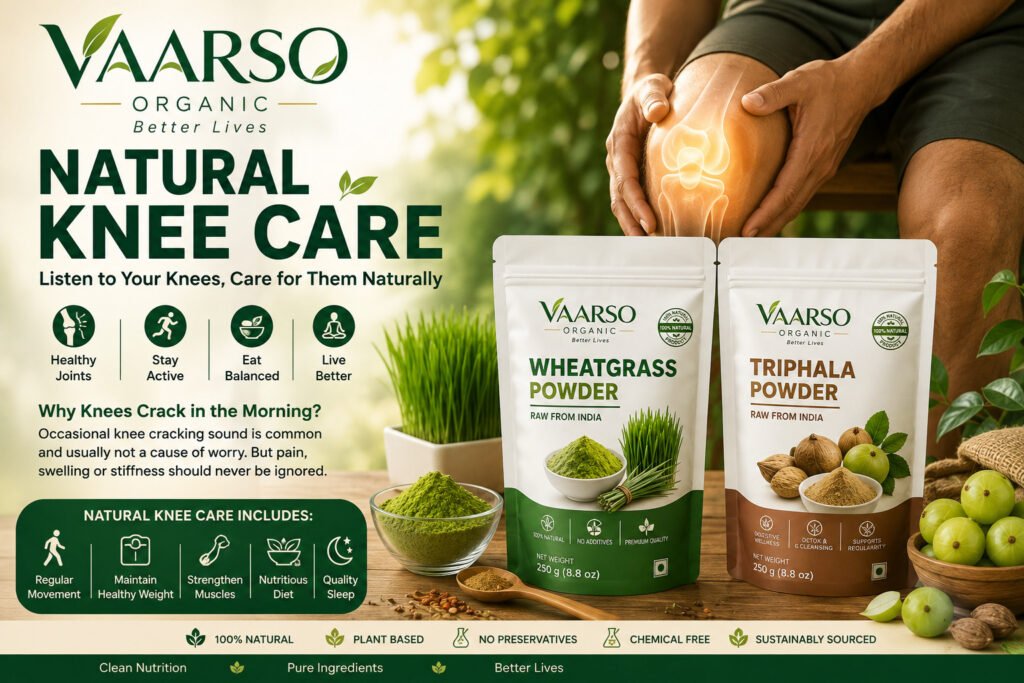
Natural knee care is not about waiting until your knees start hurting. It is about paying attention to how your knees feel, staying active, eating well and building simple habits that support your joints over time.
Have you ever got out of bed in the morning, taken a few steps and heard a little “crack,” “click” or “pop” from your knee?
You are not alone.
Knee sounds are surprisingly common. Sometimes they happen without any pain at all. In many cases, an occasional popping or cracking sound is not a serious problem. Joint noises can come from gas movement inside the joint, tendons or ligaments moving, or changes in the joint that become more noticeable with age.
But there is an important difference between a noisy knee and a painful knee.
If the cracking sound comes with swelling, warmth, persistent pain, locking, instability or difficulty walking, it is worth getting the knee checked rather than assuming it is simply part of getting older.
At Vaarso Organic, we believe natural wellness starts with everyday habits. So, instead of looking for one miracle remedy, let’s look at what you can actually do to take better care of your knees.
Note: This article is for general educational purposes. Natural foods and herbal products may support overall nutrition and wellness, but they are not substitutes for medical diagnosis or treatment.
What Does Natural Knee Care Actually Mean?
When people hear the phrase natural knee care, they sometimes think of a particular oil, powder, herb or home remedy.
But good knee care is much broader than that.
It can include:
- Regular, appropriate movement
- Maintaining healthy body weight
- Eating a balanced diet
- Getting enough protein and essential nutrients
- Supporting bone health
- Strengthening the muscles around the legs and hips
- Avoiding unnecessary strain
- Taking injuries seriously
- Getting medical advice when symptoms persist
For people who already have symptomatic knee osteoarthritis, clinical guidance supports exercise, strengthening, low-impact aerobic activity and self-management as important parts of care.
In other words, natural knee care is a lifestyle, not a quick fix.
Why Do Knees Make Cracking or Popping Sounds?
The first thing to understand is that a cracking sound does not automatically mean your knee is damaged.
Your knee is a complex joint made up of bones, cartilage, ligaments, tendons and fluid-filled structures that work together every time you walk, sit, stand or climb stairs.
Sometimes movement inside the joint creates a popping or cracking sound.
There are several possible reasons.
Gas movement inside the joint
The fluid inside a synovial joint helps the joint move smoothly. Changes in pressure can produce a popping sound. This is one common explanation for joint cracking.
Tendons and ligaments moving
Soft tissues around your knee can move as you bend and straighten your leg. Sometimes this produces a clicking or snapping sound.
Changes associated with ageing
Joint sounds can become more noticeable as people get older. Changes in cartilage and joint surfaces can contribute to creaking or grinding sensations.
Previous injury
An old sports injury, fall or other knee injury can sometimes change the way the joint moves.
Joint conditions
Knee osteoarthritis can cause symptoms such as pain, stiffness, swelling and cracking or grinding sounds. But the sound alone cannot tell you whether you have arthritis.
Is Knee Cracking Without Pain Something to Worry About?
Usually, the sound itself is less important than what comes with it.
If your knee makes a little noise when you stand up but you can walk normally and have no pain, swelling or instability, there may not be a serious problem.
Cleveland Clinic notes that joint popping is common and often isn’t concerning when it isn’t accompanied by pain or swelling.
So don’t panic every time you hear a “crack.”
Instead, ask yourself:
Does my knee hurt?
Is it swollen?
Does it feel warm?
Does it lock?
Is it becoming difficult to walk?
Those questions are more useful than focusing on the sound alone.
When Should You Take Knee Cracking Seriously?
A noisy knee deserves more attention when other symptoms appear.
Persistent pain
If your knee continues to hurt, particularly during normal activities, don’t simply ignore it.
Swelling
A swollen knee can have several causes, including injury and arthritis. Persistent swelling should be assessed.
Warmth or redness
Heat, redness and swelling may indicate inflammation or another condition that needs professional assessment.
Locking
If your knee gets stuck or you cannot fully bend or straighten it, speak to a healthcare professional.
Instability
If your knee feels like it is giving way or buckling, don’t treat it as an ordinary cracking sound.
Pain after an injury
A sudden twist, fall, sports injury or accident followed by pain or swelling should be evaluated.
Natural Knee Care Starts With Movement
One of the biggest mistakes people make when their knees start making noises is stopping all movement.
Of course, if you have an acute injury, you may need rest and professional guidance.
But in general, healthy knees benefit from appropriate movement.
For people with knee osteoarthritis, exercise—including supervised, unsupervised or aquatic exercise—is recommended over no exercise to improve pain and function.
That doesn’t mean you have to start running marathons.
Start where you are.
A short walk.
Gentle mobility.
Light strengthening.
A few minutes of movement after sitting for a long time.
These small habits can add up.
A Simple Morning Routine for Natural Knee Care
If your knees feel stiff or noisy when you get out of bed, try starting your morning slowly.
1. Sit before standing
Rather than jumping straight out of bed, sit on the edge for a few moments.
2. Move your ankles
Gently move your ankles up and down.
3. Straighten your legs
Slowly extend one leg and return it to a comfortable position. Repeat with the other.
Don’t force the movement.
4. Stand gradually
Use your hands for support if needed.
5. Take a short walk
Walk around the room or house at a comfortable pace.
The goal isn’t to “fix” a cracking knee in five minutes.
The goal is simply to start the day with gentle movement instead of sudden strain.
Walking and Natural Knee Care
Walking is one of the simplest forms of physical activity available to most people.
You don’t need expensive equipment.
You don’t need a gym membership.
And you can adjust the pace to your ability.
If you are currently inactive, start with a comfortable amount of walking and gradually build up.
If walking causes significant pain, swelling or instability, however, don’t simply push through it. Get appropriate medical advice.
Strengthening the Muscles Around Your Knees
Your knees don’t work alone.
The muscles around your thighs, hips and legs play an important role in movement and stability.
This is one reason strengthening exercises are commonly included in evidence-based knee osteoarthritis management.
Depending on your fitness level, suitable exercises may include professionally advised:
- Leg strengthening
- Step exercises
- Sit-to-stand movements
- Gentle squats
- Low-impact aerobic exercise
- Water-based exercise
If you already have knee pain, an injury or a diagnosed joint condition, a physiotherapist or other qualified healthcare professional can help you choose exercises appropriate for you.
Nutrition and Natural Knee Care
Food cannot magically repair damaged cartilage.
There is no single food that can guarantee that your knees will never hurt.
But nutrition matters.
Your body needs a wide range of nutrients to support bones, muscles and general health.
A sensible approach is to build meals around:
- Vegetables
- Fruits
- Whole grains
- Pulses and beans
- Nuts and seeds
- Dairy or suitable alternatives
- Eggs, fish or other protein sources, depending on your diet
- Adequate fluids
A balanced diet can also support healthy body weight, which is relevant to knee health.
Current guidance on osteoarthritis self-care also highlights healthy eating and weight management alongside physical activity.
Calcium and Bone Health
Calcium is an important mineral for normal bone health.
Depending on your dietary preferences, sources may include:
- Milk
- Yogurt
- Cheese
- Calcium-fortified plant beverages
- Some leafy vegetables
- Certain nuts and seeds
The goal isn’t to drink a particular amount of milk simply because your knees crack.
Instead, make sure your overall diet provides the nutrients your body needs.
Why Protein Matters for Active Adults
Protein isn’t just for gym-goers.
Your muscles need protein for maintenance and repair.
Strong muscles can help you stay active and perform everyday movements more comfortably.
Protein-rich foods include:
- Lentils
- Beans
- Eggs
- Fish
- Dairy
- Soy foods
- Nuts
- Seeds
Choose foods that suit your dietary preferences and health needs.
Don’t Forget Vitamin D
Vitamin D plays an important role in calcium metabolism and bone health.
Depending on where you live, your diet and your individual circumstances, vitamin D intake may come from food, fortified foods, sunlight exposure or supplements.
If you suspect you may have a deficiency, speak with a healthcare professional rather than taking high-dose supplements on your own.
Weight Management Is Part of Natural Knee Care
Your knees carry you throughout the day.
Walking.
Standing.
Climbing stairs.
Getting out of a chair.
Carrying groceries.
Exercise.
The more excess body weight you carry, the more demanding weight-bearing activities can become.
This is why maintaining a healthy body weight can be an important part of long-term knee care.
But avoid extreme diets.
A better approach is usually gradual:
- Eat more vegetables.
- Choose minimally processed foods more often.
- Watch portion sizes.
- Reduce excessive sugary drinks.
- Stay active.
- Sleep well.
- Make changes you can actually maintain.
For knee osteoarthritis, sustained weight loss is recommended for people who are overweight or obese because it can improve pain and function.
Vaarso Organic Approach to Natural Knee Care
At Vaarso Organic, our philosophy is simple: natural wellness should fit into real life.
We don’t believe that one powder or one ingredient should be marketed as a miracle cure for every health problem.
Instead, we focus on plant-based products that can complement a balanced lifestyle.
You can explore the range at Vaarso Organic.
Vaarso Organic Wheatgrass Powder
Vaarso Organic Wheatgrass Powder
Wheatgrass Powder can be an easy way to add a plant-based ingredient to your everyday diet.
It can be mixed into water, smoothies or other foods depending on your preference.
For a natural knee care routine, think of wheatgrass as part of your overall nutrition—not as a medicine for knee cracking, arthritis or joint pain.
A healthy knee routine works best when it includes nutritious food, movement, appropriate exercise and good lifestyle habits.
What About Vaarso Organic Triphala Powder?
Triphala is traditionally used in Ayurveda and is commonly included in wellness routines, particularly around digestive health.
For someone following a broader natural wellness lifestyle, Vaarso Organic Triphala Powder may fit into a routine focused on digestive and general wellness.
However, it is important to keep expectations realistic.
Triphala should not be described as a treatment for knee arthritis, cartilage damage or knee cracking.
If you are considering any herbal product while taking medicines or managing a health condition, discuss it with your healthcare professional.
This is especially important if you are pregnant, breastfeeding or taking regular medication.
Can Herbal Powders Stop Knee Cracking?
There is currently no good reason to promise that a herbal powder will stop a knee from cracking.
And that is something we want to make clear at Vaarso Organic.
If your knee makes a noise but doesn’t hurt, the noise itself may not need treatment.
If the cracking comes with pain, swelling, locking or instability, the right step is to identify the cause.
A food or herbal powder should never be used as a reason to delay appropriate medical care.
Foods That Fit Into a Natural Knee Care Routine
Instead of looking for one magical ingredient, create a varied plate.
Vegetables
Include different types and colors of vegetables throughout the week.
Fruits
Fresh fruits provide vitamins, minerals, fiber and other plant compounds.
Nuts and seeds
Almonds, walnuts, sesame and other nuts or seeds can add protein, healthy fats and minerals.
Whole grains
Oats, brown rice and other whole grains can form part of a balanced eating pattern.
Protein foods
Include beans, lentils, eggs, dairy, fish, soy or other suitable protein sources.
Water
Good hydration supports normal body function and helps you stay active.
What Should You Avoid for Better Knee Health?
Natural knee care isn’t only about what you add.
Sometimes it’s also about what you reduce.
Try to limit:
- Long periods of inactivity
- Sudden increases in intense exercise
- Excessive ultra-processed foods
- Regular overeating
- Crash diets
- Ignoring persistent pain
- Self-medicating repeatedly without medical advice
You don’t have to change everything in one day.
Start with one habit.
Then another.
A Simple Daily Natural Knee Care Checklist
Here’s a practical routine you can actually follow.
Morning
☑ Get out of bed slowly
☑ Do a few gentle movements
☑ Have a balanced breakfast
☑ Drink water
During the day
☑ Avoid sitting for hours without movement
☑ Walk regularly
☑ Eat vegetables and fruit
☑ Include a source of protein
☑ Maintain good posture
Evening
☑ Take a comfortable walk if appropriate
☑ Avoid excessive physical strain
☑ Eat a balanced dinner
☑ Get enough sleep
Small habits repeated every day are more useful than complicated routines followed for a week and then forgotten.
When Should You See a Doctor About Your Knee?
Don’t rely on home care if you have concerning symptoms.
Seek medical advice if you experience:
- Persistent knee pain
- Significant swelling
- Redness or warmth
- Knee instability
- Locking
- Difficulty walking
- Inability to put weight on the leg
- Pain after a fall or injury
- Symptoms that are getting progressively worse
Knee problems can have many different causes, so proper assessment matters.
Frequently Asked Questions About Natural Knee Care
Is knee cracking normal?
An occasional knee crack or pop can be normal, particularly when it occurs without pain or swelling. Joint sounds have several possible causes.
What is the best natural knee care routine?
There isn’t one universal routine. A sensible approach includes regular appropriate movement, strengthening, balanced nutrition, healthy weight management and professional advice when symptoms occur.
Can walking help knee health?
Walking can be a useful low-impact activity for many people. For people with knee osteoarthritis, exercise is recommended over no exercise to improve pain and function.
Is milk good for knee health?
Milk can provide calcium and protein and may fit into a balanced diet. However, milk does not directly treat knee cracking or arthritis.
Are almonds good for joints?
Almonds provide nutrients such as protein, healthy fats and minerals and can be part of a balanced diet. They should not be considered a treatment for joint disease.
Can Vaarso Organic Wheatgrass Powder help knee pain?
Vaarso Organic Wheatgrass Powder can be used as part of a balanced plant-based diet, but it should not be marketed or relied upon as a treatment for knee pain, arthritis or cartilage problems.
Can Triphala Powder cure knee problems?
Triphala should not be described as a cure for knee problems. It is traditionally used for general and digestive wellness, while persistent knee symptoms should be properly evaluated.
Should I stop exercising if my knees crack?
Not necessarily. A cracking sound without pain doesn’t automatically mean you need to stop exercising. However, significant pain, swelling or instability should be evaluated, and exercise should be adjusted appropriately.
Can natural remedies repair damaged knee cartilage?
There is no simple food or herbal remedy that can be guaranteed to repair damaged knee cartilage. If you have symptoms of arthritis or an injury, speak with a qualified healthcare professional.
When is knee cracking a warning sign?
Knee cracking deserves more attention when it occurs with pain, swelling, warmth, locking, instability or difficulty walking.
Final Thoughts: Listen to Your Knees
A little knee cracking sound in the morning can be startling, but the noise itself isn’t always a reason to worry.
What matters more is how your knees feel and function.
If there is no pain or swelling, keep moving, eat well and maintain healthy daily habits.
If there is pain, swelling, locking, instability or difficulty walking, don’t try to cover up the symptoms with home remedies. Find out what’s causing them.
That is what natural knee care should really mean.
Not a miracle cure.
Not an overnight solution.
Just sensible food choices, regular movement, appropriate exercise, healthy weight management and paying attention to what your body is telling you.
At Vaarso Organic, we believe natural wellness is built one everyday choice at a time.
🌿 Vaarso Organic — Natural Wellness, Simply Made.