
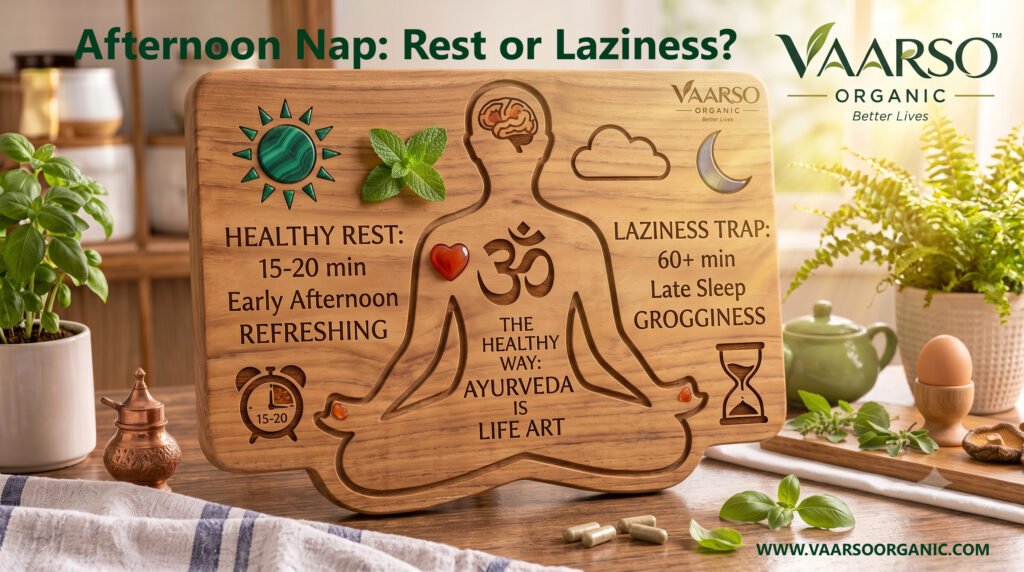
Afternoon Nap: Rest or Laziness? Benefits, Best Time & Healthy Napping Tips
There is a familiar moment after lunch when the eyes become heavy, the body feels relaxed, and the bed suddenly looks more inviting than the rest of the day.
For some people, a short afternoon nap is a refreshing pause. For others, it can turn into an hour or two of sleep followed by grogginess, reduced activity and difficulty sleeping at night.
So, is an afternoon nap healthy—or is it simply laziness?
The answer is more balanced than either extreme.
A short, well-timed nap can improve alertness, reduce tiredness and help some people feel refreshed. At the same time, a long or late-afternoon nap can interfere with nighttime sleep. Modern sleep science also recognizes that many people naturally experience a dip in alertness during the afternoon, so feeling sleepy after lunch is not necessarily a sign of laziness.
Ayurveda approaches the subject differently. Rather than asking only whether daytime sleep is “good” or “bad,” traditional Ayurvedic thinking considers the person’s constitution, season, digestion, activity, age and overall routine. Classical Ayurvedic lifestyle guidance also cautions against habitual daytime sleeping in many circumstances.
At Vaarso Organic, we believe wellness is not about following one rigid rule. It is about understanding your body, respecting natural rhythms and building sustainable daily habits.
What Is an Afternoon Nap?
An afternoon nap is a period of sleep taken during the daytime, usually after lunch or during the early-to-mid afternoon. 
A nap can be:
- Very short: around 10–20 minutes
- Short: around 20–30 minutes
- Long: 60 minutes or more
- Occasional: taken when you are unusually tired
- Regular: deliberately included in your daily routine
For most healthy adults, a short nap is generally easier to fit into a healthy sleep schedule than a long daytime sleep. The Mayo Clinic suggests keeping regular naps around 20–30 minutes, while the NHLBI advises adults to nap for no more than 20 minutes, particularly when nighttime sleep is a concern.
The ideal duration can vary from person to person.
Why Do We Feel Sleepy After Lunch?
That afternoon heaviness is not entirely your imagination.
Human alertness naturally changes throughout the day. Research has documented a mid-afternoon decline in alertness and performance, sometimes called the “post-lunch dip.” Importantly, this phenomenon can occur even when food is not the only factor involved, suggesting that our internal biological clock contributes to afternoon sleepiness.
Food can contribute as well. Studies have found that sleepiness may increase after meals, although the relationship is complicated and depends on factors such as meal size, individual differences and timing.
So when your eyes become heavy at 2 or 3 p.m., it does not automatically mean you are lazy.
Sometimes, your body is simply asking for a pause.
The important question is what you do with that signal.
Benefits of a Short Afternoon Nap
A carefully timed nap can be useful, particularly when nighttime sleep has been insufficient or when an individual experiences temporary daytime fatigue.
1. A Quick Energy Reset
One of the most obvious benefits of a short nap is feeling less tired.
A brief nap can provide a temporary boost in alertness and help you return to work, study or household activities feeling more refreshed. Mayo Clinic notes that napping may reduce tiredness and improve alertness.
Think of it as a reset button—not a replacement for nighttime sleep.
2. Better Mental Performance
Sleep is closely connected with brain function.
A short nap may help improve aspects of performance, reaction time and memory. Mayo Clinic lists improved performance, including quicker reaction time and better memory, among the potential benefits of napping.
This can be particularly useful for people whose work requires sustained attention.
3. Relaxation and Better Mood
A short period of sleep can also provide psychological relaxation.
Instead of pushing through exhaustion with another cup of coffee, a brief nap may offer a quieter way to recharge.
Mayo Clinic reports relaxation and improved mood among potential benefits of napping.
Of course, a nap is not a treatment for persistent anxiety, depression or chronic fatigue. If tiredness is frequent or unexplained, it deserves proper attention.
4. Useful After a Poor Night’s Sleep
Occasionally, life disrupts our normal sleep schedule.
Travel, long working hours, caregiving, studying, shift work or an unusually late night can reduce sleep.
In such situations, a short daytime nap can temporarily improve alertness. However, daytime sleep cannot fully replace the benefits of adequate nighttime sleep.
For adults, the CDC recommends at least seven hours of sleep per night for ages 18–60, with age-specific recommendations for older adults.
When Can an Afternoon Nap Become a Problem?
The problem is usually not the existence of a nap.
It is how long, how late and how frequently you sleep.
1. Long Naps Can Cause Grogginess
Have you ever woken from a long afternoon sleep feeling worse than before?
That heavy, confused feeling is called sleep inertia.
Longer naps make it more likely that you will wake during deeper stages of sleep, leaving you temporarily sluggish.
This is why a 20-minute nap can sometimes feel refreshing while a two-hour nap can make the rest of the afternoon disappear.
2. Late Naps May Affect Nighttime Sleep
If you regularly struggle to fall asleep at night, an afternoon nap deserves a closer look.
Napping late in the afternoon or for a long period can reduce your sleep drive at night. Mayo Clinic recommends early-afternoon naps and notes that naps after about 3 p.m. may make nighttime sleep more difficult for some people.
For someone already dealing with insomnia, reducing or avoiding daytime naps may be helpful.
3. It Can Become a Substitute for Proper Nighttime Sleep
This is where a healthy habit can slowly become an unhealthy routine.
If you sleep five hours at night, then compensate with two or three hours every afternoon, the underlying sleep problem remains.
The goal should not be:
“How can I sleep more during the day?”
Instead, ask:
“Why am I not sleeping well at night?”
Persistent daytime sleepiness can sometimes be associated with insufficient sleep, medication effects, sleep disorders or other health issues. Mayo Clinic recommends discussing an unusually increased need for naps with a healthcare professional.
Does Sleeping After Lunch Cause Weight Gain?
This popular belief needs some clarification. 
It is too simplistic to say that sleeping after lunch automatically slows metabolism and causes obesity.
Body weight is influenced by many factors, including total energy intake, physical activity, sleep, genetics, metabolic health and long-term lifestyle patterns.
However, there is a practical concern with a routine of large meals + immediate lying down + prolonged daytime sleep + low physical activity.
That combination may reflect a generally sedentary lifestyle.
So the issue is not that a 20-minute nap magically creates body fat. Rather, an inactive daily routine may contribute to poorer overall health.
A better habit is to include some gentle movement after meals and keep any nap short.
Research suggests that light activity after eating can improve the body’s post-meal glucose response compared with prolonged sitting.
Is Sleeping Immediately After Lunch Good for Digestion?
This is another area where traditional advice and modern physiology can be discussed together.
There is no good basis for saying that lying down after eating simply “stops digestion.”
Your digestive system continues working whether you are sitting, standing or sleeping.
However, lying down soon after a meal can worsen reflux symptoms in susceptible people. For people with nighttime or positional GERD symptoms, the NIDDK recommends leaving at least three hours between meals and lying down or going to bed.
This does not mean every healthy person must remain standing for hours after lunch.
It means your response matters.
If you regularly experience:
- Heartburn
- Acid reflux
- Burping
- Burning in the chest
- Sour taste
- Bloating or discomfort
after lying down following meals, changing the timing and size of meals may be worth discussing with a healthcare professional.
The Ayurvedic Perspective on Afternoon Sleep
Ayurveda views daily routine as an important part of maintaining balance.
The concept of Dinacharya, or daily regimen, emphasizes living in harmony with natural rhythms rather than treating health only when illness appears.
Daytime sleep is traditionally referred to as Divaswapna.
Ayurvedic texts and modern CCRAS lifestyle guidance do not simply promote unrestricted daytime sleeping. In several Ayurvedic lifestyle recommendations, daytime sleep is listed among habits to avoid, particularly in contexts where excess heaviness, inactivity or metabolic imbalance may be concerns.
But Ayurveda is also contextual.
It considers factors such as:
- Age
- Season
- Physical strength
- Workload
- Constitution
- Illness
- Sleep at night
- Food intake
- Digestive capacity
- Individual routine
This is one reason it is difficult to reduce Ayurveda to a single statement such as “never sleep during the day.”
Traditional wisdom often asks a better question:
Does this habit support your body’s balance, or is it creating heaviness and inactivity?
That question remains surprisingly relevant today.
What Does “Ayurveda = Life Art” Mean Here?
Ayurveda can be understood not only as a system of traditional medicine, but also as a philosophy of everyday living.
The lesson from an afternoon nap is simple:
Rest has value. Excess has consequences.
A person who works physically all morning may need a short period of rest.
A person who slept poorly the previous night may benefit from a brief nap.
Someone who sleeps eight hours at night and feels energetic may not need a daily nap.
Another person may find that a long afternoon sleep leaves them unable to sleep at night.
The same habit can therefore affect different people differently.
That is where the idea of mindful living becomes important.
Afternoon Nap and Nutrition: What You Eat Matters Too
Although a nap itself contains no nutrition, the meal before it can influence how you feel afterward.
A very large, heavy lunch may leave you feeling more sluggish than a balanced meal.
Instead of building lunch around excessive refined carbohydrates, fried foods and sugary desserts, consider a balanced plate containing:
- Vegetables
- Whole grains or other high-fibre carbohydrates
- Adequate protein
- Healthy fats in sensible amounts
- Fresh foods
- Water
A balanced eating pattern can support steady energy throughout the day.
The goal is not to avoid carbohydrates or fats completely. It is to avoid making every lunch excessively heavy.
For people who experience a strong afternoon energy crash, observing what they eat, how much they eat and how they feel afterward can be more useful than simply blaming the nap.
How to Take a Healthy Afternoon Nap
If you enjoy an afternoon nap and it does not disturb your nighttime sleep, here is a practical routine.
Step 1: Choose the right time
Aim for the early afternoon, rather than late evening.
A nap around the middle of the afternoon may fit naturally with the body’s normal decline in alertness.
Step 2: Keep it short
Try approximately 15–20 minutes as a starting point.
Some people may prefer up to 30 minutes, but longer naps increase the chance of grogginess.
Step 3: Set an alarm
Don’t rely on “I’ll just close my eyes for a few minutes.”
A short nap can easily become a long sleep when you are already tired.
Step 4: Create a calm environment
Keep the space quiet, comfortable and reasonably dark.
You don’t necessarily need a perfect bedroom. Even a peaceful chair or comfortable resting area can work.
Step 5: Give yourself time to wake up
Don’t jump directly from sleep into an important meeting, driving or demanding physical activity.
Allow a few minutes for your alertness to return.
Step 6: Notice the effect
Ask yourself:
“Do I feel better after this nap—or worse?”
Your answer is valuable information.
What About a 20-Minute Nap After Lunch?
A 20-minute nap can be a reasonable option for many healthy adults.
But there is one important distinction:
Resting is not the same as sleeping.
You could finish lunch, take a gentle walk, sit quietly, practice breathing or meditation, and then decide whether you actually need a nap.
This approach can prevent every afternoon energy dip from automatically becoming sleep.
A Simple Vaarso Organic Afternoon Routine
Here is a practical routine inspired by both modern wellness principles and the broader Ayurvedic idea of mindful daily living.
After lunch:
0–10 minutes:
Finish your meal calmly. Avoid immediately lying down.
10–25 minutes:
Take a gentle walk or remain comfortably upright.
25–30 minutes:
Drink water according to your thirst and routine.
30 minutes onward:
If you still feel genuinely sleepy, consider a short nap.
After waking:
Wash your face, get some natural light and resume gentle activity.
This is not a medical prescription. It is simply a practical wellness routine that can be adapted to individual needs.
What If You Don’t Want to Sleep?
You don’t have to.
A nap is an option—not a health requirement.
Try:
Meditation
Five to ten minutes of quiet breathing can create a sense of mental rest without putting you into a full sleep cycle.
Gentle walking
Walking after a meal can break up prolonged sitting and may support a healthier post-meal glucose response.
Natural daylight
Getting outside during the day can support a healthy sleep-wake rhythm.
Quiet rest
Close your eyes, breathe slowly and relax for several minutes without trying to fall asleep.
Sometimes the body needs rest, not sleep.
Who May Need Extra Caution With Afternoon Naps?
People with the following situations may want to pay particular attention to daytime sleep:
- Persistent insomnia
- Frequent nighttime awakenings
- Excessive daytime sleepiness
- Suspected sleep apnea
- Unexplained fatigue
- Very long daily naps
- Difficulty functioning after waking
- Regular need for multiple naps
If you suddenly need much more daytime sleep than usual, it is worth discussing the change with a healthcare professional.
A nap should not become a way of hiding persistent exhaustion.
Afternoon Nap: Rest or Laziness?
Perhaps the most useful answer is:
Neither, by itself.
A short nap can be a sensible form of recovery.
A long, habitual nap that replaces nighttime sleep and physical activity may become part of an unhealthy routine.
The difference lies in purpose, duration, timing and individual response.
Think about it this way:
Short nap + good nighttime sleep + active lifestyle = potentially useful rest.
Long nap + poor nighttime sleep + prolonged inactivity = a habit worth reconsidering.
There is no need to feel guilty about a 20-minute nap if your body benefits from it.
At the same time, there is no need to sleep simply because it is lunchtime.
Listen to your body—but also understand your body’s signals.
Final Thoughts: Rest With Awareness
Modern life often pushes us toward two extremes: either work continuously or feel guilty for resting.
Healthy living requires neither.
Rest is part of wellness.
Movement is part of wellness.
Good food is part of wellness.
Quality nighttime sleep is part of wellness.
And sometimes, a short afternoon nap fits beautifully into that picture.
The real goal is not to ask, “Is afternoon sleep good or bad?”
A better question is:
“Does this rest help me live the rest of my day better?”
That is where traditional wisdom and modern sleep science can meet.
Ayurveda reminds us that daily habits matter. Modern sleep research reminds us that timing and duration matter too. Together, they encourage something simple: rest mindfully, stay active, eat sensibly and protect your nighttime sleep.
At Vaarso Organic — Better Lives, we believe wellness is built through small, consistent choices rather than extreme rules.
Ayurveda is not simply about medicines. It can also be understood as an art of living with awareness.
Frequently Asked Questions
1. Is a 20-minute afternoon nap healthy?
For many healthy adults, a short nap of around 20 minutes can improve alertness and reduce fatigue without causing significant nighttime sleep disruption. Individual responses vary.
2. Is sleeping after lunch bad?
Not necessarily. A short early-afternoon nap can be useful for some people. However, lying down immediately after meals may worsen reflux in susceptible individuals, and long naps may interfere with nighttime sleep.
3. Does afternoon sleep cause weight gain?
A short nap does not automatically cause weight gain. Weight is influenced by overall diet, activity, sleep and many other factors. The concern is more about a long, inactive lifestyle than a brief nap itself.
4. What is the best nap duration?
Around 15–20 minutes is a practical starting point for many adults. Mayo Clinic describes 20–30 minutes as an ideal range, while NHLBI advises adults to keep naps to no more than 20 minutes.
5. What is sleep inertia?
Sleep inertia is the temporary grogginess, reduced alertness or disorientation that can occur after waking, especially from a longer nap.
6. Can a nap replace nighttime sleep?
No. A nap may temporarily improve alertness, but it cannot provide all the benefits of adequate nighttime sleep.
7. Is afternoon sleep recommended in Ayurveda?
Ayurvedic approaches to daytime sleep are contextual. Traditional guidance commonly cautions against habitual daytime sleeping in many circumstances, particularly when excess heaviness and inactivity are concerns. Individual factors and circumstances matter.
8. Should I walk after lunch instead of sleeping?
A gentle walk can be a useful option, especially if you tend to become sedentary after meals. Research indicates that post-meal activity can improve the immediate glucose response compared with inactivity.
9. Can I nap if I have insomnia?
If you have difficulty falling or staying asleep at night, daytime naps may sometimes make the problem worse. NHLBI and Mayo Clinic recommend limiting or avoiding naps when they interfere with nighttime sleep.
10. Is feeling sleepy after lunch normal?
It can be. Afternoon sleepiness is associated with natural circadian changes, and meals can also influence post-meal sleepiness.
11. What should I do if I feel sleepy every afternoon?
Look at your nighttime sleep, meal size, activity, medications and overall routine. If excessive daytime sleepiness is persistent or increasing, consult a healthcare professional rather than relying on naps alone.
12. Can meditation replace a nap?
Meditation can provide relaxation without sleep, but it does not necessarily provide the same physiological functions as sleep. Think of meditation and napping as different forms of rest rather than direct substitutes.