
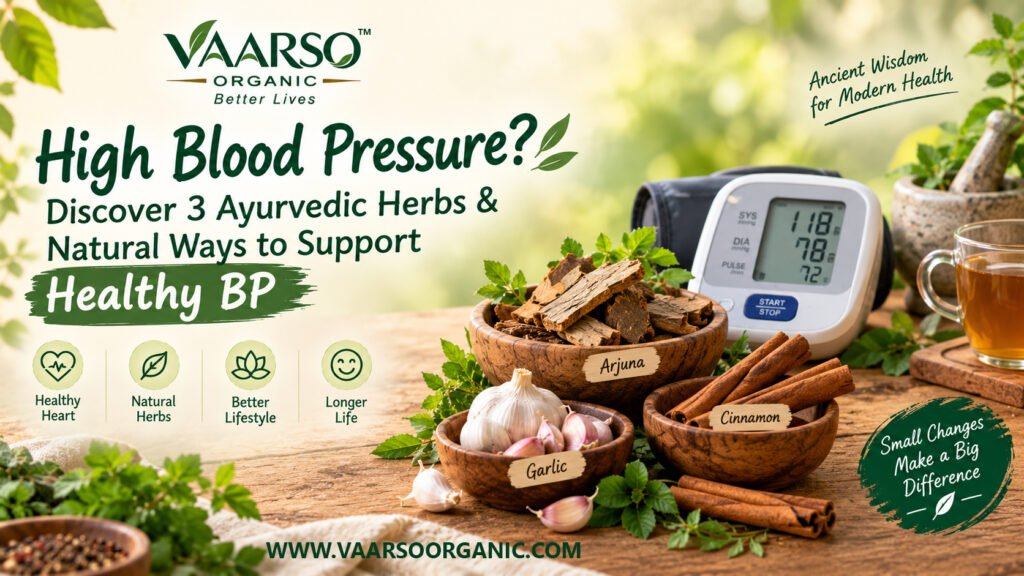
Ayurvedic Herbs for Blood Pressure: Arjuna, Garlic & Cinnamon
High blood pressure rarely announces itself.
There may be no warning pain, no obvious discomfort and sometimes no symptoms at all. A person can feel perfectly normal while blood pressure is gradually putting extra strain on the heart, blood vessels, brain and kidneys.
That is one reason hypertension deserves attention—not fear.
The good news is that blood pressure is influenced by many everyday factors. Food choices, salt intake, physical activity, body weight, alcohol, tobacco, stress, sleep and appropriate medical treatment can all make a difference. According to the World Health Organization, around 1.4 billion adults aged 30–79 had hypertension worldwide in 2024, and many were unaware that they had it.
Ayurveda approaches health from a broader perspective. Traditional Indian health philosophy has never been only about taking a particular herb when a problem appears. It places importance on Ahara (food), Vihara (lifestyle), Dinacharya (daily routine), Agni (digestion), rest, mental balance and individual suitability.
Among the herbs traditionally associated with cardiovascular wellness are Arjuna, garlic and cinnamon. Modern research has also investigated some of these ingredients, although the evidence is not strong enough to call them cures for hypertension or substitutes for prescribed medicines.
So, can Ayurveda have a place in a blood-pressure-friendly lifestyle?
Yes—but the right way to approach it is with knowledge rather than exaggerated promises.
This guide from Vaarso Organic explores three traditional ingredients, their potential benefits, nutrition, practical uses, Ayurvedic perspective, safety considerations and lifestyle habits that can support healthier blood pressure.
Important: This article is for educational purposes and is not a substitute for medical care. If you have hypertension or take blood-pressure medication, do not stop, reduce or replace your medicine with an herb without discussing it with your doctor or qualified healthcare professional.
What Is High Blood Pressure? 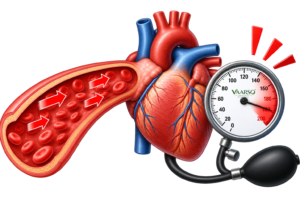
Blood pressure is the force created by circulating blood against the walls of the arteries.
It is represented by two numbers:
- Systolic pressure – pressure when the heart contracts.
- Diastolic pressure – pressure when the heart relaxes between beats.
WHO defines hypertension as blood pressure of 140/90 mmHg or higher, confirmed through measurements taken on two different days. Individual treatment targets can differ depending on overall cardiovascular risk and other health conditions.
The important thing is not to judge your health from one isolated reading.
Blood pressure naturally changes throughout the day because of activity, stress, sleep, caffeine, illness and other factors.
Regular monitoring gives a much clearer picture.
Why Should Blood Pressure Be Taken Seriously?
When blood pressure stays elevated for a long time, the cardiovascular system has to work harder.
Uncontrolled hypertension can increase the risk of: 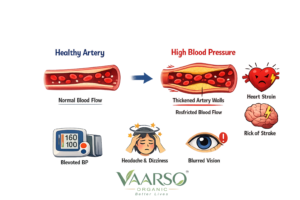
- Heart disease
- Stroke
- Kidney disease
- Heart failure
- Damage to blood vessels
- Other cardiovascular complications
And because hypertension can exist without noticeable symptoms, feeling fine does not necessarily mean your blood pressure is fine.
This is perhaps one of the most important lessons for modern wellness:
Don’t wait for your body to complain before you start caring for it.
Ayurveda and Blood Pressure: Looking Beyond One Number
The modern concept of hypertension does not map perfectly onto a single classical Ayurvedic diagnosis.
Ayurveda uses a different framework to understand health and imbalance.
Traditional Ayurvedic thinking gives importance to:
Ahara – Food
What we eat influences the body every day.
Vihara – Lifestyle
Movement, sleep, work, rest and daily habits all matter.
Agni – Digestion
Ayurveda places considerable importance on digestion and the body’s ability to process food appropriately.
Manas – Mental Wellbeing
Stress, emotional strain and lack of rest are important parts of a person’s overall wellbeing.
Dinacharya – Daily Routine
Regularity and healthy routines are central ideas in traditional Ayurvedic living.
This broader approach is particularly interesting when thinking about blood pressure because modern medicine also recognizes lifestyle factors such as excess sodium, inactivity, excess weight, alcohol and stress as important contributors to hypertension.
1. Arjuna: The Traditional Heart-Wellness Herb 
If there is one Ayurvedic herb that immediately comes to mind when discussing traditional cardiovascular wellness, it is Arjuna (Terminalia arjuna).
Arjuna bark has a long history in Ayurvedic practice and is traditionally associated with Hridaya, or heart-related wellbeing.
It is commonly found in Ayurvedic powders, decoctions and classical formulations.
Why Is Arjuna Interesting?
Arjuna contains naturally occurring plant compounds including tannins, flavonoids and other phytochemicals that have attracted scientific interest.
Traditional Ayurvedic use has focused particularly on cardiovascular and heart-related wellness.
However, it is important not to turn traditional reputation into an unsupported medical promise.
Arjuna should not be described as a guaranteed cure for high blood pressure or as a replacement for antihypertensive medication.
Potential Benefits of Arjuna
As a traditional wellness herb, Arjuna is commonly associated with:
- Cardiovascular support
- Traditional heart care
- General vitality
- Support for healthy circulation
- Ayurvedic wellness routines
The scientific evidence around Arjuna is still developing, and its role in blood-pressure management is not established strongly enough to replace conventional treatment.
How Is Arjuna Traditionally Used?
Arjuna is available in several forms:
- Arjuna bark powder
- Decoctions
- Capsules
- Tablets
- Classical Ayurvedic preparations
The correct amount depends on the preparation and individual circumstances.
Rather than assuming that everyone should take exactly one teaspoon every morning, it is better to follow the instructions for the specific product or seek guidance from a qualified Ayurvedic practitioner.
2. Garlic: A Traditional Food With Modern Research Behind It 
Garlic (Allium sativum) is perhaps one of the easiest traditional ingredients to include in everyday food.
It has been used across cultures for centuries, including in Indian traditional practices.
Unlike many exotic herbal ingredients, garlic is already part of ordinary cooking around the world.
And there is some scientific interest in its relationship with blood pressure.
NCCIH states that limited evidence suggests garlic supplements may reduce blood pressure to a small extent in people with hypertension, although the evidence is not strong enough to consider garlic equivalent to blood-pressure medication.
Potential Benefits of Garlic
Garlic provides naturally occurring sulfur-containing compounds and other plant constituents.
It can contribute to a healthy diet by:
- Adding flavour without relying heavily on salt
- Providing plant compounds
- Supporting variety in the diet
- Being an easy ingredient in heart-conscious meals
How to Use Garlic
Instead of treating garlic like a medicine, use it as a food.
Try it in:
- Vegetable curries
- Soups
- Lentils
- Roasted vegetables
- Whole-grain dishes
- Homemade sauces
- Salad dressings
- Stir-fries
Fresh garlic can be particularly useful when reducing salt because strong natural flavours make healthy meals more enjoyable.
What About Eating Raw Garlic?
Some people prefer raw garlic, but more is not necessarily better.
Raw garlic can cause:
- Heartburn
- Stomach discomfort
- Gas
- Nausea
- Strong breath and body odour
Garlic supplements may also increase bleeding risk and can interact with medicines, particularly anticoagulants and aspirin.
So the popular idea of calling garlic a “natural blood thinner” is too simplistic.
Garlic is a food with potentially useful properties—not a substitute for medical treatment.
3. Cinnamon: A Spice Worth Enjoying, Not Overusing 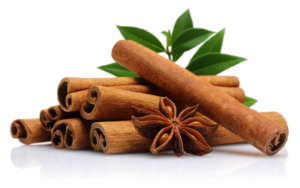
Cinnamon, or Dalchini, has a special place in traditional food culture.
Its warm aroma and naturally sweet flavour make it useful when preparing foods and drinks without relying heavily on added sugar.
Cinnamon has also been studied for several health conditions, including blood pressure.
But the evidence needs to be understood carefully.
NCCIH states that research does not clearly support cinnamon supplementation for a specific health condition, and studies are difficult to compare because different species and preparations are used.
Potential Benefits of Cinnamon
As a culinary ingredient, cinnamon can:
- Add flavour naturally
- Reduce the need for excessive sugar in some foods
- Provide plant compounds
- Complement a varied, minimally processed diet
- Fit naturally into traditional food practices
How to Use Cinnamon
A small culinary quantity can be added to:
- Oatmeal
- Porridge
- Yogurt
- Fruit
- Herbal beverages
- Smoothies
- Homemade recipes
Cinnamon Safety
There is an important difference between using cinnamon as a spice and consuming concentrated amounts regularly.
Cassia cinnamon can contain significant amounts of coumarin, which may be a concern with prolonged high intake, particularly for people with liver disease. Ceylon cinnamon generally contains much less coumarin.
So don’t assume that a larger dose means a greater benefit.
Should You Make an Arjuna + Cinnamon Decoction Every Morning?
This is a common type of Ayurvedic home-remedy recommendation.
The traditional idea of preparing herbs as a decoction has a genuine place in Ayurvedic practice. However, there is no universally established recipe proving that one spoon of Arjuna powder plus half a spoon of cinnamon boiled down to half a glass will control hypertension for everyone.
People differ in:
- Age
- Blood-pressure levels
- Kidney function
- Liver function
- Other medical conditions
- Medicines
- Dietary patterns
- Individual tolerance
Therefore, if you want to use an Arjuna preparation, choose a properly identified product and follow appropriate professional or product guidance.
Ayurveda values individual suitability. A fixed recipe cannot automatically be right for every person.
What About Garlic With Cow’s Ghee?
Garlic and ghee are both traditional foods, and the combination may be familiar in Indian households.
But several popular claims need to be treated cautiously.
There is no reliable evidence that garlic with ghee:
- “Cleans blocked arteries”
- Permanently cures high blood pressure
- Prevents blood from becoming “thick”
- Repairs damaged blood vessels
Ghee is also concentrated in fat, including saturated fat, so the quantity matters within the overall diet.
If you enjoy garlic with a small amount of ghee as part of your traditional food routine, that’s a dietary choice—not a proven hypertension treatment.
Can Foot Massage Lower Blood Pressure?
Padabhyanga, or traditional foot massage, is an interesting part of Ayurvedic self-care.
Massaging the feet with oil or ghee may feel soothing and can become a relaxing bedtime ritual.
And relaxation itself has value.
Some complementary approaches, including relaxation techniques and yoga, have shown modest effects on blood pressure in some research, although evidence varies.
But the claim that rubbing the soles with a copper bowl for a fixed number of minutes will pull high blood pressure away from the head and immediately lower it is not established by good scientific evidence.
Therefore:
Use Padabhyanga as relaxation—not as emergency treatment for high blood pressure.
The Most Important “Ayurvedic Medicine” May Be Your Daily Routine
This may sound less exciting than a powerful herbal formula, but it is probably more useful.
Blood pressure responds to the way we live every day.
WHO recommends healthy eating, reducing sodium, being physically active, maintaining a healthy weight where appropriate, avoiding tobacco and limiting alcohol as important measures for preventing and managing hypertension.
Ayurveda’s traditional emphasis on routine makes this particularly relevant.
Think about your daily rhythm.
What do you eat?
How much salt do you consume?
Do you move your body?
How well do you sleep?
How often do you feel constantly stressed?
Do you regularly check your blood pressure?
These questions may be more important than finding one “miracle” herb.
Salt: Don’t Let “Natural” Become Misleading
One of the biggest misconceptions around blood pressure is that replacing ordinary white salt with Himalayan pink salt or another “natural” salt automatically makes the diet healthier.
It doesn’t.
Pink salt still contains sodium.
WHO recommends that adults consume less than 5 grams of salt per day, equivalent to less than 2,000 mg of sodium.
So instead of simply changing the colour of your salt, focus on reducing the total amount.
Be particularly aware of hidden sodium in:
- Pickles
- Papad
- Instant noodles
- Processed meats
- Packaged snacks
- Sauces
- Ready meals
- Restaurant foods
- Salted biscuits and crackers
- Processed cheese
For people around the world, this is increasingly important because much of our sodium intake can come from packaged and processed foods rather than the salt shaker alone.
Should You Stop Gym and Exercise If You Have High BP?
Absolutely not as a general rule.
This is one of the most important misconceptions to correct.
Regular physical activity is a key part of cardiovascular health.
WHO recommends adults aim for at least 150 minutes of moderate-intensity aerobic activity per week, or 75 minutes of vigorous activity, with muscle-strengthening activities on at least two days a week when appropriate.
That could mean:
- Walking
- Cycling
- Swimming
- Dancing
- Jogging
- Strength training
- Yoga
- Sports
- Active household activities
If someone has severely uncontrolled blood pressure, cardiovascular disease or symptoms such as chest pain or unusual breathlessness, they should discuss exercise intensity with a healthcare professional.
The goal isn’t to avoid movement.
The goal is to move intelligently.
Nutrition for Healthy Blood Pressure
No herb can compensate for a poor overall diet.
A blood-pressure-friendly eating pattern can include:
Vegetables
Leafy greens, carrots, tomatoes, broccoli, peppers and other colourful vegetables.
Fruits
Whole fruits provide fibre and potassium along with many other nutrients.
Whole Grains
Oats, whole-grain breads, brown rice, quinoa and other minimally processed grains can contribute fibre.
Beans and Lentils
Useful sources of plant protein and fibre.
Nuts and Seeds
Unsalted nuts and seeds can contribute healthy fats and minerals.
Healthy Fats
Emphasize unsaturated fat sources while keeping highly processed and excessive saturated-fat intake in check.
Herbs and Spices
Garlic, cinnamon, ginger, turmeric, herbs and other seasonings can make food flavourful while helping reduce dependence on excessive salt.
A Simple Ayurvedic-Inspired Daily Routine
Here is a practical approach that can work for people in different parts of the world.
Morning
Start your day with water and a nourishing breakfast.
If an Ayurvedic herb such as Arjuna is part of your routine, use an appropriate preparation under professional guidance.
Breakfast
Choose whole grains, fruit, yogurt or another nutritious protein source.
Daytime
Move regularly rather than sitting continuously for long periods.
Lunch
Build your meal around vegetables, a protein source and a suitable whole-grain or other carbohydrate source.
Evening
Take a walk, exercise or practise gentle yoga according to your fitness level.
Dinner
Keep highly salty and heavily processed foods occasional rather than everyday staples.
Before Bed
A calm routine—reading, gentle breathing, meditation or traditional foot massage—may help create a relaxing transition to sleep.
Every Day
Check your blood pressure according to the schedule recommended by your healthcare professional.
What Ayurveda Can Teach Us About Prevention
There is an old idea in Indian health traditions that prevention is wiser than waiting for disease to become severe.
In modern language, this means paying attention to risk factors before they become complications.
Ayurveda’s emphasis on routine, moderation, digestion, seasonal awareness and mental balance can be valuable as a lifestyle philosophy.
But modern medicine gives us tools Ayurveda did not have centuries ago:
- Blood-pressure monitors
- Clinical diagnosis
- Kidney-function testing
- Cardiovascular risk assessment
- Imaging
- Controlled clinical trials
- Evidence-based medicines
There is no reason to choose between respect for traditional wisdom and respect for modern medical science.
The two can coexist when each is used appropriately.
When Is High Blood Pressure an Emergency?
If a blood-pressure reading is around 180/120 mmHg or higher, especially if repeated after a short period of rest, it should not be managed by trying a new herbal remedy at home.
If very high blood pressure occurs together with symptoms such as:
- Chest pain
- Severe headache
- Shortness of breath
- Confusion
- Weakness or numbness
- Difficulty speaking
- Vision changes
- Severe dizziness
seek urgent medical attention.
WHO notes that very high blood pressure can be associated with serious symptoms and requires immediate care when concerning symptoms are present.
A herbal tea is not an emergency treatment.
Final Thoughts: Ayurveda Is More Than a Bottle of Medicine
When people hear the word Ayurveda, they sometimes immediately think about powders, capsules, oils or decoctions.
But Ayurveda can be much broader than that.
It can mean paying attention to food.
It can mean respecting digestion.
It can mean creating a regular routine.
It can mean making time for movement.
It can mean learning to slow down.
It can mean using herbs thoughtfully instead of casually.
Arjuna, garlic and cinnamon each have an interesting place in traditional wellness, and some have been investigated for possible effects related to blood pressure. But none should be presented as a guaranteed cure for hypertension.
The strongest foundation remains remarkably simple:
Eat well. Reduce excess sodium. Move regularly. Maintain a healthy weight where appropriate. Sleep enough. Manage stress. Monitor your blood pressure. Use herbs responsibly. And take prescribed treatment when you need it.
That is not “less Ayurvedic.”
It may actually be closer to the deeper idea of Ayurveda as a way of living wisely every day.
At Vaarso Organic, we believe natural wellness should be built on a balance of traditional knowledge, responsible use and modern understanding.
Vaarso Organic — Better Lives.
Frequently Asked Questions
1. Which Ayurvedic herbs are commonly associated with blood pressure support?
Arjuna is traditionally associated with heart and cardiovascular wellness. Garlic and cinnamon are also commonly discussed, although scientific evidence for their blood-pressure effects varies.
2. Can Arjuna cure high blood pressure?
There is not enough evidence to describe Arjuna as a cure for hypertension. It may be used traditionally for cardiovascular wellness, but it should not replace prescribed treatment.
3. Can garlic help with blood pressure?
Limited evidence suggests garlic supplements may modestly reduce blood pressure in people with hypertension. The effect is not comparable to established blood-pressure medicines.
4. Can cinnamon control high blood pressure?
The evidence is currently unclear. Cinnamon can be a useful culinary spice, but it should not be relied upon as a treatment for hypertension.
5. Can I stop my BP medicine after starting Ayurveda?
No. Never stop or change prescribed blood-pressure medicine without medical advice. Treatment helps reduce the risk of serious complications.
6. Is pink Himalayan salt better for blood pressure?
Not simply because it is pink or considered natural. It still contributes sodium. The important factor is keeping total sodium intake under control.
7. Should people with high blood pressure avoid the gym?
Not generally. Regular physical activity is beneficial for cardiovascular health and blood-pressure management. Exercise intensity should be appropriate for the individual’s health.
8. Can Padabhyanga immediately reduce high blood pressure?
Foot massage may be relaxing, but there is no reliable evidence that it can rapidly treat dangerously high blood pressure.
9. Is garlic with cow’s ghee a treatment for hypertension?
No. It may be enjoyed as part of traditional food practices, but there is no reliable evidence that this combination cures hypertension or cleans blocked arteries.
10. Can I take garlic supplements with blood thinners?
Speak with your healthcare professional first. Garlic supplements may increase bleeding risk and can interact with medicines.
11. Is cinnamon safe to consume every day?
Small culinary amounts are generally considered safe for most people. Larger or prolonged amounts, particularly of cassia cinnamon, may increase exposure to coumarin. People with liver disease should be especially cautious.
12. What is the best natural way to manage blood pressure?
There is no single natural remedy. A combination of healthy eating, lower sodium intake, regular physical activity, healthy weight management, adequate sleep, stress management, blood-pressure monitoring and appropriate medical treatment is much more reliable.