
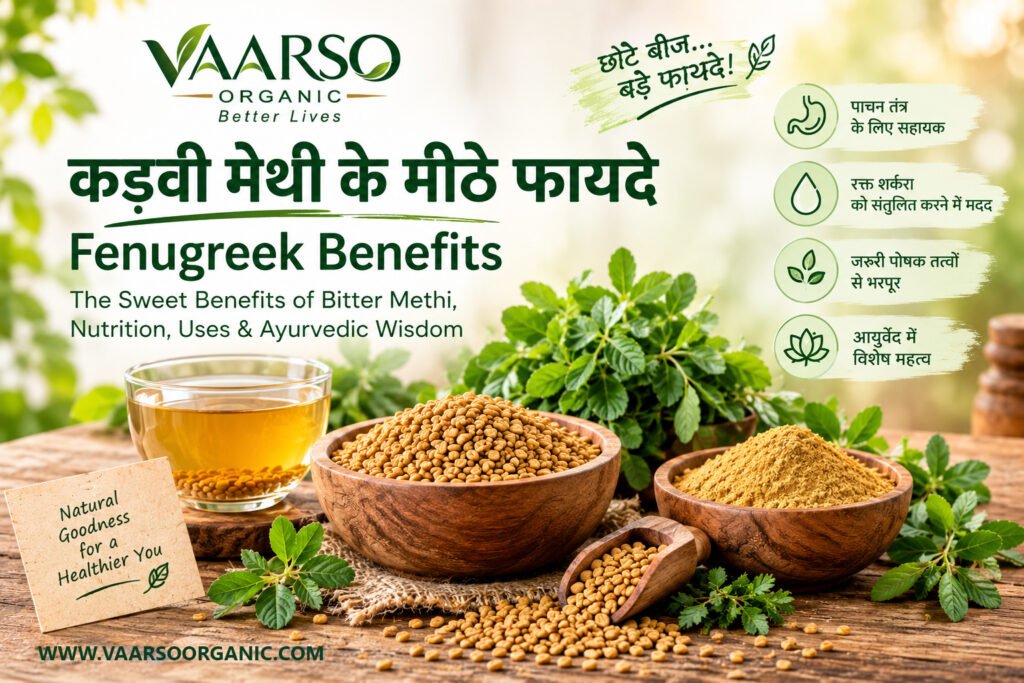
Fenugreek Benefits: The Sweet Benefits of Bitter Methi, Nutrition, Uses & Ayurvedic Wisdom
Methi is one of those ingredients that has been part of traditional kitchens for generations. Its slightly bitter taste may not win everyone over immediately, but that bitterness is also part of what makes fenugreek so distinctive.
Known as methi in Hindi and Methika in classical Ayurvedic literature, fenugreek is used as both a culinary spice and a traditional herbal ingredient. The seeds are commonly added to curries, pickles, spice blends and drinks, while fresh methi leaves are used in vegetables, flatbreads and other everyday dishes.
Modern nutrition research has also increased interest in fenugreek because its seeds contain dietary fibre, protein, minerals and a variety of plant compounds. Some clinical studies have investigated fenugreek for blood-sugar and metabolic health, although the evidence is not strong enough to consider it a treatment or cure for any disease.
So, what exactly makes this humble seed so interesting?
Let us explore fenugreek benefits, nutrition, traditional Ayurvedic wisdom, uses and practical ways to include methi in everyday life.
What Is Fenugreek?
Fenugreek is scientifically known as Trigonella foenum-graecum. It belongs to the Fabaceae family and is cultivated in many parts of the world. 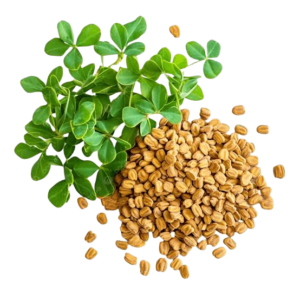
The plant produces small, yellowish-brown seeds with a characteristic aroma and slightly bitter taste. The fresh leaves are also widely eaten as methi greens.
Fenugreek has a long history as a food and traditional herbal ingredient. According to the U.S. National Center for Complementary and Integrative Health (NCCIH), fenugreek has been used as a spice and traditional medicine for thousands of years.
This combination of food + tradition + nutrition is what makes fenugreek particularly interesting.
Fenugreek Benefits: Why Is Methi So Popular?
The benefits of fenugreek should be understood as part of an overall healthy lifestyle rather than as a substitute for medical treatment.
Here are some of the reasons people include methi in their daily diets.
1. Fenugreek May Support Digestive Wellness
Fenugreek seeds contain a considerable amount of dietary fibre. Fibre is an important part of a healthy diet because it supports normal bowel function and contributes to digestive health.
Traditionally, fenugreek has been used in various cultures as a digestive and culinary herb.
The seeds can absorb water and develop a soft, mucilaginous texture after soaking. This is one reason soaked fenugreek seeds are traditionally used in some household wellness routines.
However, more is not necessarily better. A sudden large increase in fenugreek or other high-fibre foods can cause bloating, loose stools or digestive discomfort in some people.
Simple approach: introduce it gradually and use a moderate amount.
2. Fenugreek Contains Dietary Fibre
One of the most interesting nutritional features of fenugreek seeds is their fibre content.
USDA-derived nutrition data lists approximately 24.6 g of dietary fibre per 100 g of dried fenugreek seed, along with about 23 g protein.
Of course, nobody needs to consume 100 g of fenugreek seeds in a normal meal. Fenugreek is generally used in much smaller quantities as a spice or ingredient.
Nevertheless, its nutritional composition helps explain why this small seed has attracted attention.
Fibre can contribute to:
- Normal digestive function
- Greater dietary variety
- Satiety as part of a balanced meal
- A healthy overall eating pattern
The important point is that fenugreek complements a fibre-rich diet; it does not replace vegetables, fruits, legumes or whole grains.
3. Fenugreek May Support Healthy Blood-Sugar Management
This is one of the most researched areas of fenugreek.
Several clinical trials and systematic reviews have examined fenugreek in people with type 2 diabetes or impaired glucose regulation.
A 2023 systematic review and meta-analysis of 10 randomized controlled trials involving 706 participants reported improvements in some blood-glucose measures, including fasting blood glucose, two-hour glucose and HbA1c. The researchers also noted limitations in the available evidence.
Another meta-analysis involving 14 trials and 894 participants found potential benefits but also highlighted concerns about study quality and heterogeneity.
An updated meta-analysis published in 2025 also reported improvements in several glycemic parameters, while noting the need for higher-quality research.
So what should the everyday reader take from this?
Fenugreek may have a role in supporting healthy glucose metabolism, but it should not be presented as a diabetes cure.
People taking diabetes medication should be especially careful because concentrated fenugreek may affect blood glucose. Medical guidance is appropriate before using larger supplemental amounts. NCCIH also notes that large doses may cause an undesirable drop in blood sugar.
4. Methi Provides Useful Plant Nutrients
Fenugreek seeds contain more than fibre.
USDA-derived data per 100 g of dried seeds reports approximately: 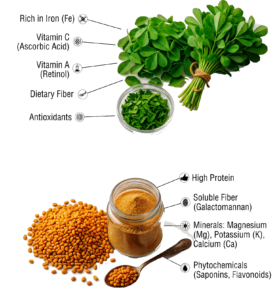
| Nutrient | Amount per 100 g |
|---|---|
| Energy | 323 kcal |
| Protein | 23 g |
| Carbohydrate | 58.4 g |
| Dietary fibre | 24.6 g |
| Fat | 6.4 g |
| Calcium | 176 mg |
| Iron | 33.5 mg |
| Magnesium | 191 mg |
| Potassium | 770 mg |
| Phosphorus | 296 mg |
| Zinc | 2.5 mg |
These values are for dried seeds per 100 g and should not be interpreted as the nutritional intake from a normal teaspoon-sized serving.
The exact nutritional composition can also vary according to variety, growing conditions, processing and preparation.
Still, the profile demonstrates why fenugreek can be considered a nutrient-containing culinary seed rather than merely a flavouring.
5. Fenugreek May Contribute to Cardiometabolic Wellness
Fenugreek has also been studied for several markers associated with metabolic health, including blood glucose and blood lipids.
Some systematic reviews have reported improvements in certain glucose and lipid parameters among people using fenugreek preparations. However, research methods, preparations, dosages and participant groups differ considerably.
This makes it difficult to translate research findings into a universal recommendation for everyone.
The practical lesson is much simpler:
Using fenugreek as part of a balanced diet can be one small component of a healthy lifestyle.
It should be combined with:
- Regular physical activity
- Adequate sleep
- Plenty of vegetables
- Appropriate protein
- Whole grains and legumes
- Healthy fats
- Reasonable portion sizes
- Limited excess sugar and highly processed foods
No single herb can replace these foundations.
6. Fenugreek Adds Plant Variety to the Diet
Modern nutrition increasingly encourages dietary variety.
Instead of depending on one “superfood,” a healthier approach is to include many different plant foods throughout the week.
Fenugreek can contribute to this diversity.
You can use:
- Fresh methi leaves
- Whole methi seeds
- Lightly roasted fenugreek seeds
- Fenugreek powder
- Methi in traditional spice blends
- Methi-based vegetable dishes
The flavour is strong, so only a small amount may be needed.
That makes fenugreek particularly useful as a culinary ingredient.
Fenugreek and Ayurveda: The Traditional Perspective
Fenugreek has an established place in classical Ayurvedic herbal literature under the name Methika.
Ayurvedic references describe Methika in traditional terms related to taste, qualities and effects on the doshas. Classical references include works such as Bhavaprakash Nighantu, where Methika is discussed among medicinal plants.
Some Ayurvedic sources describe fenugreek using concepts such as Katu Rasa, Ushna Virya and actions associated traditionally with Vata and Kapha.
This traditional framework is different from modern nutrition science.
It is also important to make a distinction between Vedic literature and later Ayurvedic medical texts. It would be inaccurate to claim that the Vedas specifically described modern concepts such as blood-glucose regulation, HbA1c or cholesterol.
The detailed medicinal classification of Methika belongs more appropriately to the later Ayurvedic materia medica and classical medical tradition.
That distinction allows us to appreciate Ayurveda without putting modern scientific claims into ancient texts.
The Ayurvedic Idea of Agni and Methi
One of the most familiar Ayurvedic concepts is Agni, often translated broadly as digestive fire.
Traditional Ayurveda places considerable importance on digestion, appetite, food quality and the body’s ability to process what is consumed.
Fenugreek’s bitter and pungent character has traditionally been associated with digestive functions.
From a modern perspective, fenugreek’s fibre and plant compounds provide a different way of understanding why it has attracted nutritional interest.
These are two different frameworks:
Ayurveda: traditional concepts of Agni, Rasa, Guna, Virya and Dosha.
Modern nutrition: fibre, protein, minerals, phytochemicals and clinical research.
They can be discussed alongside each other, provided that traditional claims are clearly identified as traditional rather than presented as modern clinical facts.
How to Use Fenugreek in Everyday Life
There is no single “correct” way to consume methi.
The best approach is often the simplest one: use it as food.
1. Add Methi Seeds to Cooking
Whole methi seeds can be used in:
- Vegetable preparations
- Curries
- Pickles
- Spice mixes
- Lentil dishes
- Homemade masalas
Because the flavour can become bitter when over-roasted, gentle cooking is usually preferable.
2. Use Fresh Methi Leaves
Fresh methi leaves can be incorporated into:
- Methi paratha
- Vegetable dishes
- Dal
- Soups
- Savoury pancakes
- Stuffed breads
- Mixed greens
Fresh leaves provide a different nutritional profile from dried seeds and are an easy way to include leafy vegetables in meals.
Vaarso Organic’s broader wellness philosophy also emphasizes using natural ingredients as part of realistic everyday eating rather than depending on complicated routines.
3. Fenugreek Powder
Fenugreek seeds can be ground into powder and used in small quantities.
You can add a little fenugreek powder to:
- Soups
- Vegetable preparations
- Lentils
- Homemade spice blends
- Savoury dough
- Certain herbal recipes
Because the flavour is strong and bitter, start with a small quantity.
4. Soaked Fenugreek Seeds
Soaking methi seeds overnight is a traditional household practice.
The soaked seeds become softer and easier to chew.
Some people also drink the soaking water as part of a traditional morning routine.
However, there is no need to treat fenugreek water as a miracle detox drink.
Hydration, balanced meals, physical activity and adequate sleep remain much more important foundations of wellness.
Should You Drink Fenugreek Water Every Morning?
Fenugreek water has become popular on social media, but popularity is not the same as scientific proof.
Soaking a small quantity of fenugreek seeds in water can be a traditional way of consuming the ingredient. However, claims that it automatically “detoxes the liver,” “melts belly fat,” “cures diabetes” or “cleans the blood” go beyond what current evidence supports.
A sensible approach is to view it simply as one optional food-based habit.
If it causes bloating, nausea, loose stools or discomfort, stop using it.
Fenugreek for Women’s Wellness
Fenugreek has traditionally been used for several aspects of women’s health.
It has been studied for menstrual symptoms and breastfeeding, but the evidence remains uncertain.
NCCIH reports that studies investigating fenugreek for increasing breast milk supply have produced mixed results. It also advises against using fenugreek during pregnancy in amounts greater than those normally found in food because of potential safety concerns.
Therefore:
Food quantities and concentrated herbal supplements should not be treated as the same thing.
Pregnant or breastfeeding women should speak with a qualified healthcare professional before using fenugreek in medicinal or concentrated amounts.
Fenugreek Safety: Who Should Be Careful?
Fenugreek is generally considered safe in the quantities normally found in foods.
However, larger amounts may cause:
- Diarrhea
- Nausea
- Bloating
- Digestive discomfort
- Low blood sugar
- Allergic reactions
NCCIH specifically advises people taking medicines to consult a healthcare professional because herbs can interact with medicines.
Extra care is appropriate if you:
- Take diabetes medication
- Take prescription medicines regularly
- Are pregnant
- Are breastfeeding
- Have a known allergy to fenugreek or related plants
- Are considering high-dose supplements
Most importantly, do not replace prescribed diabetes or other medical treatment with fenugreek.
Vaarso Organic also advises customers to consult a qualified healthcare professional before using supplements when pregnant, breastfeeding, taking prescription medication or living with a medical condition.
Methi in Traditional Indian Food Culture
Perhaps the greatest strength of fenugreek is that it does not have to be treated as a complicated supplement.
Indian food culture already knows how to use it.
A small amount of methi can transform the flavour of a dish.
Fresh leaves can bring an earthy bitterness to a vegetable preparation.
Seeds can add depth to a spice mixture.
Powder can be incorporated into savoury recipes.
This is an important lesson from traditional food cultures: many herbs were not consumed separately as “health products.” They were simply part of meals.
That approach remains relevant today.
How Much Fenugreek Should You Use?
There is no universally established daily dose of fenugreek for general wellness.
The amount used in clinical research varies significantly depending on the preparation.
Therefore, it is better not to copy a high-dose supplement protocol from a research paper and assume it is appropriate for everyday use.
For general culinary use, think of fenugreek as a spice or food ingredient rather than a medicine.
If you are considering concentrated fenugreek supplements, speak with a qualified healthcare professional—especially if you take medication.
Fenugreek: Food First, Claims Second
The internet is full of dramatic claims about methi.
You may see statements such as:
“Fenugreek cures diabetes.”
“Fenugreek melts belly fat.”
“Fenugreek removes toxins.”
“Fenugreek guarantees hair growth.”
These statements are much stronger than the available evidence.
A better way to describe fenugreek is:
Fenugreek is a nutrient-containing culinary herb and traditional ingredient that may offer certain wellness benefits, with some promising but still developing clinical evidence.
That description is less sensational—but much more responsible.
Why Fenugreek Fits the Vaarso Organic Philosophy
At Vaarso Organic, the focus is on bringing together natural ingredients, traditional wisdom and modern practices while keeping wellness practical for everyday life.
Fenugreek fits naturally into this philosophy.
It is:
- Traditional
- Plant-based
- Versatile
- Nutrient-containing
- Easy to use in food
- Familiar across many cultures
But natural does not automatically mean risk-free.
Responsible herbal wellness means understanding both the potential benefits and the limitations.
That is why fenugreek should be viewed as part of a broader lifestyle—not as a replacement for medical care.
Final Thoughts: The Sweet Side of a Bitter Seed
Fenugreek may taste bitter, but there is much more to this little seed than its flavour.
Its history stretches across food and traditional herbal practices. Modern nutritional data shows that fenugreek seeds contain fibre, protein and several minerals. Research has also explored its potential role in glucose and metabolic health, although further high-quality research is needed before making strong therapeutic claims.
Ayurvedic tradition gives Methika its own place within classical herbal knowledge, while modern nutrition looks at its fibre, nutrients and plant compounds.
Perhaps the most practical way to appreciate methi is not to search for a miracle benefit.
Simply use it wisely.
Add fresh methi to meals.
Use a small amount of seeds in cooking.
Experiment with traditional recipes.
Keep your overall diet varied.
And remember that healthy living is built from many small habits—not one magical ingredient.
Sometimes, the bitterest ingredients can add something valuable to a balanced life.
At Vaarso Organic, this balance between traditional wisdom and responsible modern wellness is at the heart of our philosophy.
Frequently Asked Questions About Fenugreek
1. What are the main fenugreek benefits?
Fenugreek provides dietary fibre, protein and minerals. Research has also investigated its potential effects on blood glucose and lipid parameters. However, it should not be considered a cure for diabetes or other diseases.
2. Is fenugreek the same as methi?
Yes. Fenugreek is commonly known as methi in Hindi and several Indian languages. The classical Ayurvedic name is Methika.
3. Can I eat fenugreek seeds every day?
Fenugreek can be used regularly as a culinary ingredient. However, concentrated or high-dose use is different from normal food use. People taking medicines should consult a healthcare professional before using larger amounts.
4. Is fenugreek good for digestion?
Fenugreek contains substantial dietary fibre and has traditionally been used as a digestive herb. However, larger quantities may actually cause digestive symptoms such as bloating or diarrhea in some people.
5. Does fenugreek lower blood sugar?
Some clinical research suggests fenugreek may improve certain blood-glucose measures, but evidence has limitations and it should not replace prescribed diabetes treatment.
6. Can I drink fenugreek water in the morning?
Soaked fenugreek water is a traditional practice. It can be included as part of a routine if it suits you, but there is insufficient evidence to support exaggerated “detox” or disease-cure claims.
7. Is fenugreek safe during pregnancy?
Fenugreek in amounts greater than those normally found in food is not considered safe during pregnancy. Consult your healthcare professional before using fenugreek medicinally.
8. Can breastfeeding mothers use fenugreek?
Fenugreek has traditionally been used to support milk production, but research has produced mixed results and safety data for larger amounts during breastfeeding are limited.
9. Is fenugreek rich in protein?
Yes. USDA-derived data lists approximately 23 g of protein per 100 g of dried fenugreek seeds.
10. Is fenugreek high in fibre?
Yes. Dried fenugreek seeds contain approximately 24.6 g of dietary fibre per 100 g according to USDA-derived data.
11. Can I use fenugreek powder instead of seeds?
Yes. Fenugreek powder can be used in cooking and traditional recipes. Because its flavour is strong and bitter, a small quantity is generally sufficient.
12. Does fenugreek cure diabetes?
No. Fenugreek should not be described as a cure for diabetes. Some research suggests potential benefits for glucose control, but people with diabetes should continue appropriate medical care and discuss herbal products with their healthcare professional.